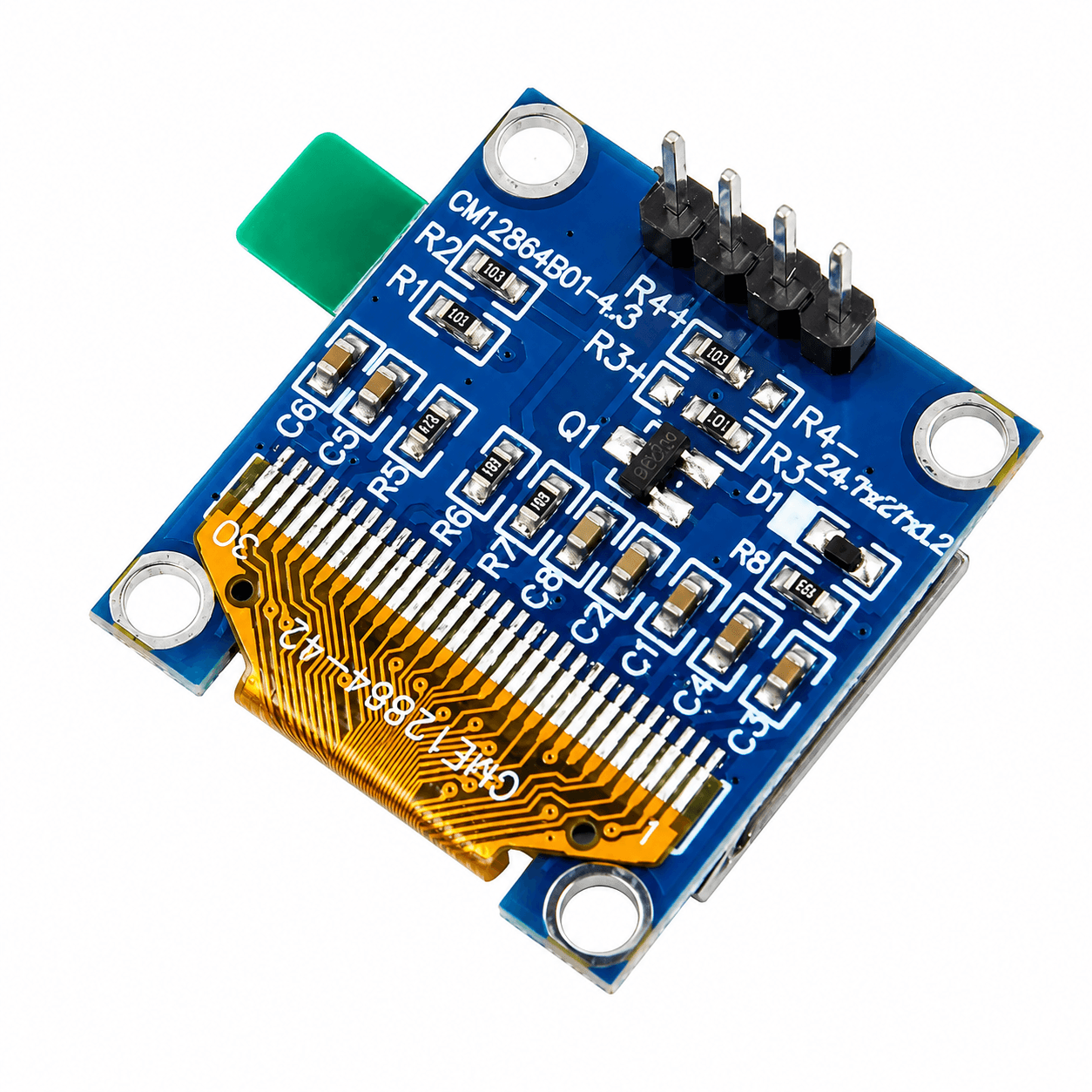
0.96 Inch OLED Display Module

SKU: 0ASVYHGDJS
★★★★
4.7 (50 reviews)
The 0.96 Inch OLED Display Module is a compact graphical display module designed for displaying text, numbers, icons, graphics, sensor readings, and simple animations in embedded electronics projects. Common versions feature a 128 × 64 pixel resolution and use the popular SSD1306 OLED display controller, providing sharp and high-contrast graphics in a very small form factor. Unlike conventional LCD displays,...
Regular price Rs. 189.00
Regular price Rs. 199.00 Sale price Rs. 189.00
Save Rs. 10
Sold out
Tax included. Shipping calculated at checkout.
COD Available
Easy Return
Quality Assured
12 people are viewing this right now
For Bulk Order Contact Us View full product details
Same Day Dispatch Order before 2PM
Pan India Delivery Shipping in 24-48H
Secure Packaging Safe & Damage Free
Dedicated Support Expert Assistance

The 0.96 Inch OLED Display Module is a compact graphical display module designed for displaying text, numbers, icons, graphics, sensor readings, and simple animations in embedded electronics projects. Common versions feature a 128 × 64 pixel resolution and use the popular SSD1306 OLED display controller, providing sharp and high-contrast graphics in a very small form factor.

Unlike conventional LCD displays, OLED technology is self-emissive, meaning that each pixel produces its own light and no separate backlight is required. This provides excellent contrast, wide viewing angles, fast response, and low power consumption, making the module ideal for portable and battery-powered applications.

The commonly available 4-pin version communicates using the I2C interface, requiring only two signal lines—SDA and SCL—for communication. The module can be easily interfaced with Arduino, ESP32, STM32, Raspberry Pi, PIC, AVR, RP2040, and other compatible development platforms. Common 0.96-inch SSD1306 I2C modules use four connections: VCC, GND, SCL, and SDA.

Key Features

  • Compact 0.96-inch OLED display
  • 128 × 64 pixel graphical resolution
  • SSD1306 display controller on common module versions
  • High contrast display output
  • Self-emissive OLED technology
  • No backlight required
  • I2C communication interface on common 4-pin versions
  • Requires only two microcontroller communication pins
  • Wide viewing angle of more than 160°
  • Low power consumption
  • Fast display response
  • Supports text, numbers, icons, graphics, and bitmaps
  • Compact and lightweight PCB design
  • Suitable for portable and battery-powered projects
  • Compatible with popular graphics libraries
  • Easy interfacing with microcontrollers and development boards

Shipping & Returns

Orders placed before 3 PM IST will be shipped on the same day (excluding Sundays and Public holidays) through our shipping partners. In rare cases, the pickup may get delayed during Public holidays / Bandh / Environmental disturbances.

Specifications

Specifications:

Display Type: Graphic OLED Display Module
Display Size: 0.96 Inch Diagonal
Display Technology: OLED (Organic Light-Emitting Diode)
Resolution: 128 × 64 Pixels
Controller IC: SSD1306 on Common Versions
Display Mode: Monochrome
Display Color: Blue, White, or Yellow/Blue, Depending on Variant
Interface: I2C on Common 4-Pin Modules
Operating Voltage: Typically 3V to 5V, Depending on Module Version
Viewing Angle: Greater than 160°
Backlight: Not Required
Active Display Area: Approximately 21.74mm × 10.86mm
Typical Module Dimensions: Approximately 27mm × 27mm
Pixel Control: Individual Pixel Addressing
I2C Address: Commonly 0x3C; some variants support 0x3D
Communication Pins: SDA and SCL
Power Consumption: Low and Content Dependent
Operating Temperature: Module Dependent
Mounting Type: PCB Module with Pin Header
Compatibility: Arduino UNO, Nano, Mega, ESP32, ESP8266, STM32, Raspberry Pi, RP2040, PIC, AVR and other compatible controllers.

Additional Resources

FAQ

1. What is the 0.96 Inch OLED Display Module used for?

The module is used to display text, numbers, icons, graphics, sensor readings, menus, and simple animations in embedded systems, IoT devices, robotics, portable instruments, and microcontroller projects.

2. Is the 0.96 Inch OLED Display compatible with Arduino and ESP32?

Yes. The display can be used with Arduino, ESP32, ESP8266, STM32, Raspberry Pi, RP2040, PIC, AVR, and other development platforms that support the module's communication interface.

3. Does the OLED display require a backlight?

No. OLED pixels generate their own light, so the display does not require a separate backlight. This provides high contrast and helps reduce power consumption compared with many backlit display technologies.

4. What is the typical I2C address of the 0.96 Inch OLED Display?

The most common I2C address is 0x3C. Some module variants can use 0x3D, depending on the display configuration and hardware design.

5. Can the 0.96 Inch OLED Display show graphics and images?

Yes. The 128 × 64 pixel display can show text, icons, logos, bitmaps, graphs, and simple animations. The available content is limited by the display resolution and the memory resources of the controlling microcontroller.