

Bulk Orders Available
Special Pricing for Schools, Colleges & Businesses


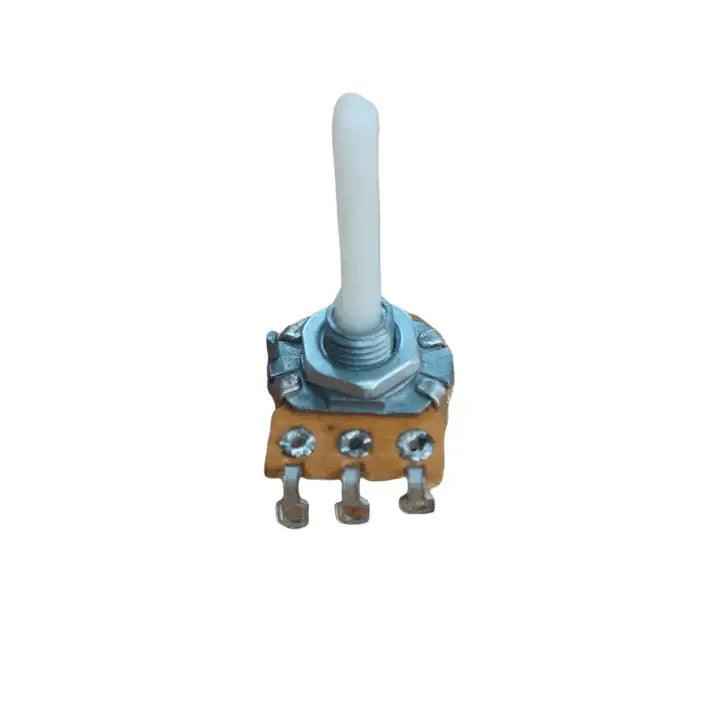
Potentiometers are widely used to adjust electrical parameters in a circuit. This is a single-turn 1MΩ potentiometer equipped with a rotating knob. It is commonly known as a rotary potentiometer or simply a POT. A knob can also be added for better handling and improved appearance.
This potentiometer features a carbon track and provides a single-turn adjustable resistance of 1MΩ. It is designed for panel mounting and comes with a knob attached to its plastic spindle. Rotating the knob turns the spindle, which in turn changes the resistance. The resistance varies linearly with the angle of rotation, allowing smooth and precise control.
In electronics, a potentiometer is a manually adjustable resistor. It is most commonly used in consumer devices for volume or tone control, which is why it is often informally referred to as a “volume” or “tone” control. Unlike measuring instruments, it does not have a scale or pointer.
Potentiometers come in various shapes and sizes depending on their power rating, application, resistance value, and materials used. However, all potentiometers share a basic structure: a resistive track and a wiper that moves along it. The two ends of the resistive element, along with the wiper, serve as terminals, enabling the user to obtain a variable resistance between the wiper and either end.
Orders placed before 3 PM IST will be shipped on the same day (excluding Sundays and Public holidays) through our shipping partners. In rare cases, the pickup may get delayed during Public holidays / Bandh / Environmental disturbances.