
Couldn't load pickup availability
Orders placed before 3 PM IST will be shipped on the same day (excluding Sundays and Public holidays) through our shipping partners. In rare cases, the pickup may get delayed during Public holidays / Bandh / Environmental disturbances.


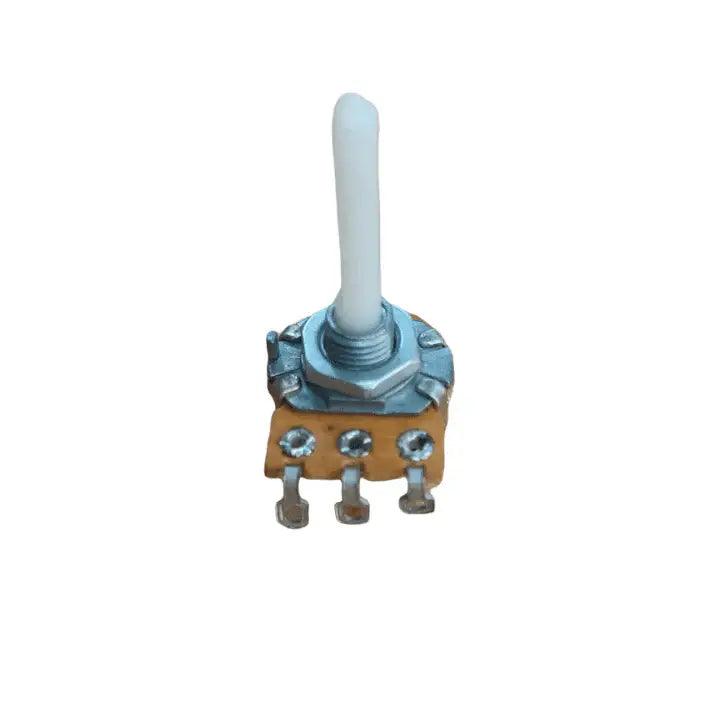
Potentiometers are widely used components for adjusting electrical parameters in a circuit. This is a single-turn 220K potentiometer with a rotating shaft, commonly known as a rotary potentiometer or simply a “POT.” A knob can be attached to enhance usability and appearance.
This device features a carbon track with an adjustable resistance of 220 kΩ and is designed for panel mounting. It comes with a knob fitted onto a plastic shaft, which, when rotated, changes the resistance. The resistance varies linearly with the angle of rotation, allowing smooth and precise control.
In electronics, a potentiometer is a manually adjustable resistor. It is most commonly used for controlling audio levels, such as volume or tone in sound systems, which is why it is often informally referred to as a “volume” or “tone” control. However, it is not a measuring instrument and does not have a scale or needle.
Potentiometers come in various shapes and sizes depending on their application, power rating, resistance value, and materials used. Despite these differences, they all share a common working principle: a wiper moves across a resistive track, creating variable resistance. The two ends of the resistive element and the wiper are accessible as terminals, allowing the user to obtain a variable resistance or voltage output.


