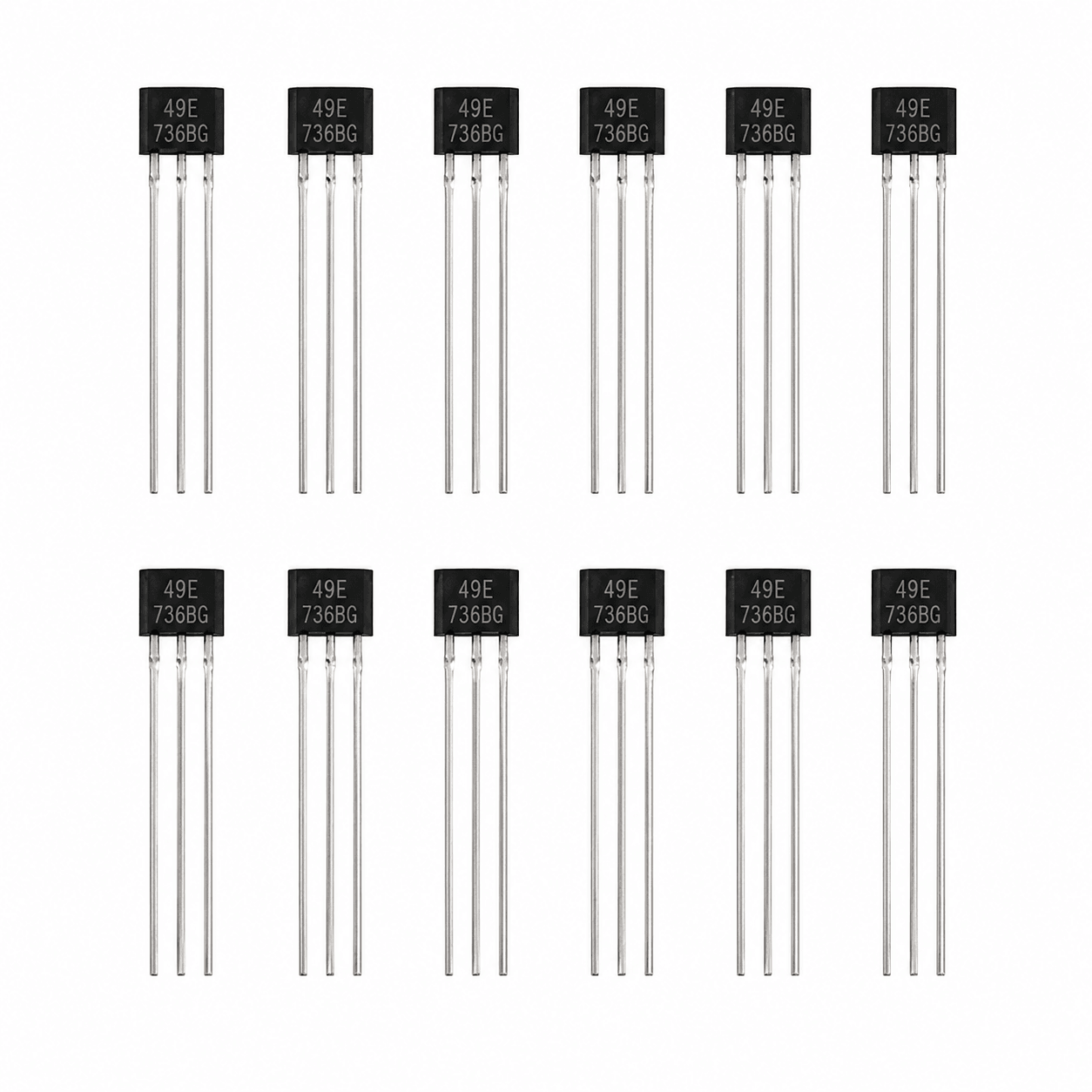
49E Linear Hall-Effect Sensor

SKU: FJSL140DM9
★★★★
4.7 (60 reviews)
The 49E Linear Hall-Effect Sensor is a high-sensitivity analog magnetic field sensor designed to detect both the strength and polarity of magnetic fields. Unlike digital Hall sensors that simply switch ON or OFF, the 49E provides a continuous analog voltage output that changes proportionally with the magnetic field intensity, making it ideal for precision sensing applications. The sensor is based...
Regular price Rs. 29.00
Regular price Rs. 35.00 Sale price Rs. 29.00
Save Rs. 6
Sold out
Tax included. Shipping calculated at checkout.
COD Available
Easy Return
Quality Assured
12 people are viewing this right now
For Bulk Order Contact Us View full product details
Same Day Dispatch Order before 2PM
Pan India Delivery Shipping in 24-48H
Secure Packaging Safe & Damage Free
Dedicated Support Expert Assistance

The 49E Linear Hall-Effect Sensor is a high-sensitivity analog magnetic field sensor designed to detect both the strength and polarity of magnetic fields. Unlike digital Hall sensors that simply switch ON or OFF, the 49E provides a continuous analog voltage output that changes proportionally with the magnetic field intensity, making it ideal for precision sensing applications.

The sensor is based on the Hall Effect principle and can detect both North and South magnetic poles. When no magnetic field is present, the output voltage is approximately half of the supply voltage. As the magnetic field strength changes, the output voltage increases or decreases linearly depending on the polarity of the magnetic field.

Housed in a compact TO-92 package, the 49E sensor is widely used in position sensing, motor speed detection, current sensing, magnetic field measurement, proximity detection, robotics, industrial automation, and embedded electronics. It is fully compatible with Arduino, ESP32, STM32, Raspberry Pi Pico, AVR, PIC, and other microcontroller platforms.

Key Features

  • Linear analog Hall-effect sensor
  • Measures magnetic field strength and polarity
  • Detects both North and South magnetic poles
  • High sensitivity and excellent linearity
  • Analog voltage output
  • Low noise output
  • Low power consumption
  • Wide operating voltage range
  • Fast response time
  • Compact TO-92 package
  • Stable temperature performance
  • Easy microcontroller interfacing
  • Compatible with Arduino, ESP32, STM32, and Raspberry Pi
  • Ideal for industrial, automotive, and DIY electronics projects

Shipping & Returns

Orders placed before 3 PM IST will be shipped on the same day (excluding Sundays and Public holidays) through our shipping partners. In rare cases, the pickup may get delayed during Public holidays / Bandh / Environmental disturbances.

Specifications

Specifications:

Component Type: Linear Hall-Effect Sensor
Model: 49E (AH49E / WSH49E / SS49E Compatible)
Sensor Type: Linear Analog Hall Sensor
Package: TO-92 Through-Hole
Detection Principle: Hall Effect
Operating Voltage: 2.7V to 6.5V DC
Typical Supply Voltage: 5V DC
Operating Current: Approximately 4mA to 7mA
Output Type: Analog Voltage Output
Output Voltage (No Magnetic Field): Approximately VCC ÷ 2
Sensitivity: Approximately 1.4mV/Gauss to 3.0mV/Gauss (Model Dependent)
Maximum Output Current: 20mA
Response Time: Fast Response
Magnetic Pole Detection: North and South Pole
Operating Temperature: -40°C to +85°C (Typical)
Storage Temperature: -40°C to +100°C
Mounting Type: Through-Hole
Package Dimensions: TO-92 Standard Package
Compatibility: Arduino, ESP32, STM32, Raspberry Pi Pico, AVR, PIC

Additional Resources

FAQ

1. What is the 49E Linear Hall-Effect Sensor used for?

The 49E sensor is used to measure magnetic field strength and polarity in applications such as position sensing, motor speed detection, current sensing, robotics, industrial automation, and proximity detection.

2. How does the 49E Hall-Effect Sensor work?

The sensor operates on the Hall Effect principle and produces an analog voltage proportional to the strength and direction of the magnetic field. With no magnetic field present, the output is approximately half of the supply voltage.

3. Can the 49E sensor detect both North and South magnetic poles?

Yes. The sensor can detect both magnetic poles. The output voltage increases for one pole and decreases for the opposite pole, allowing it to determine both magnetic field strength and polarity.

4. Can the 49E be connected directly to Arduino and ESP32 boards?

Yes. The sensor operates from approximately 2.7V to 6.5V and provides an analog output that can be directly connected to the analog input pins of Arduino, ESP32, STM32, Raspberry Pi Pico, and other microcontrollers.

5. What is the difference between the 49E and a digital Hall sensor?

The 49E provides a continuous analog voltage proportional to the magnetic field strength, making it suitable for measurement applications. A digital Hall sensor only switches HIGH or LOW when the magnetic field exceeds a preset threshold, making it suitable for simple presence detection.