AD8232 ECG Module Heart Rate Monitor Kit

SKU: 6UIRKH7KVH
★★★★
4.5 (148 reviews)
The AD8232 ECG Heart Rate Monitor Sensor Module with ECG Cables & Electrodes is a compact bio-signal acquisition module designed for monitoring the electrical activity of the heart and displaying an ECG waveform in electronics, educational, fitness, and experimental monitoring projects. The module is based on the AD8232 integrated single-lead heart-rate monitor front end, which is designed to extract, amplify,...
Regular price Rs. 1,120.00
Regular price Rs. 1,199.00 Sale price Rs. 1,120.00
Save Rs. 79
Sold out
Tax included. Shipping calculated at checkout.
COD Available
Easy Return
Quality Assured
12 people are viewing this right now
For Bulk Order Contact Us View full product details
Same Day Dispatch Order before 2PM
Pan India Delivery Shipping in 24-48H
Secure Packaging Safe & Damage Free
Dedicated Support Expert Assistance

The AD8232 ECG Heart Rate Monitor Sensor Module with ECG Cables & Electrodes is a compact bio-signal acquisition module designed for monitoring the electrical activity of the heart and displaying an ECG waveform in electronics, educational, fitness, and experimental monitoring projects.

The module is based on the AD8232 integrated single-lead heart-rate monitor front end, which is designed to extract, amplify, and filter small biopotential signals in noisy conditions such as those caused by motion or remote electrode placement. The processed ECG signal is provided as an analog output, allowing it to be read by a microcontroller ADC or viewed on suitable data-acquisition equipment.

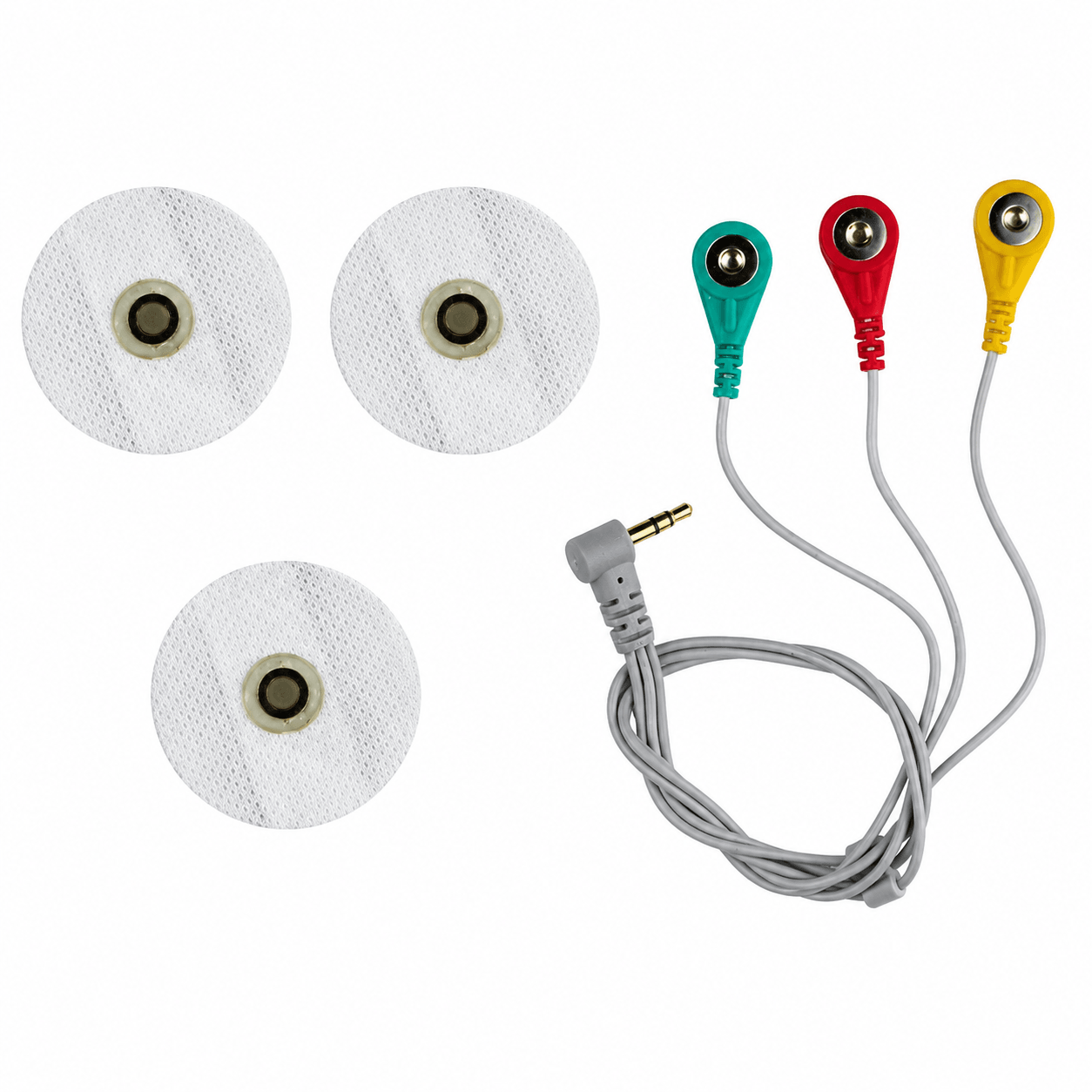
The kit includes the AD8232 sensor module, 3-lead ECG cable, and adhesive electrode pads, providing the main components required for ECG signal acquisition experiments. The module includes connections for RA (Right Arm), LA (Left Arm), and RL (Right Leg) electrodes, along with LO+ and LO− lead-off detection outputs that can help detect disconnected electrodes.

With its analog output, compact size, low-power operation, and simple interface, the AD8232 module is suitable for Arduino, ESP32, STM32, Raspberry Pi Pico, and other ADC-equipped development platforms. It is widely used in ECG waveform visualization, heart-rate experiments, wearable electronics prototypes, fitness monitoring projects, and biomedical electronics education.

Key Features

  • Based on the AD8232 ECG signal-conditioning IC
  • Single-lead ECG signal acquisition
  • Measures the electrical activity of the heart
  • Provides a conditioned analog ECG waveform output
  • Integrated signal amplification and filtering
  • Designed for small biopotential signal acquisition
  • Three-electrode ECG measurement configuration
  • Includes ECG lead cable
  • Includes adhesive electrode pads
  • Built-in leads-off detection support
  • LO+ and LO− electrode-disconnection outputs
  • Shutdown control input
  • Heartbeat indicator LED on common module versions
  • 3.5mm electrode cable connector on common boards
  • Low-power operation
  • High common-mode rejection
  • Compact PCB module design
  • Easy connection to microcontroller analog inputs
  • Suitable for ECG waveform plotting
  • Ideal for educational and experimental bio-signal projects

Shipping & Returns

Orders placed before 3 PM IST will be shipped on the same day (excluding Sundays and Public holidays) through our shipping partners. In rare cases, the pickup may get delayed during Public holidays / Bandh / Environmental disturbances.

Specifications

Specifications:

Module Type: ECG / Heart Electrical Activity Sensor Module
Sensor IC: AD8232
Measurement Type: Single-Lead ECG Signal Acquisition
Signal Type: Cardiac Biopotential Signal
Output Type: Analog Voltage Output
Electrode Configuration: 3-Electrode Configuration on Common Modules
Electrode Connections: RA, LA and RL
Operating Voltage: 3.3V DC for Common Breakout Modules
AD8232 IC Supply Range: 2.0V to 3.5V
Typical AD8232 Supply Current: Approximately 170µA
Shutdown Current: Less Than Approximately 1µA at IC Level
Common-Mode Rejection Ratio: Approximately 80dB from DC to 60Hz
Input Bias Current: Approximately 200pA Typical
Input Noise: Approximately 7µV Peak-to-Peak over 0.5Hz to 40Hz
Output Signal: Conditioned Analog ECG Waveform
Lead-Off Detection: Supported
Lead-Off Outputs: LO+ and LO−
Shutdown Control: SDN Pin
Electrode Connector: 3.5mm Jack on Common Module Versions
Status Indicator: Heartbeat LED on Common Module Versions
Typical Module Dimensions: Approximately 35mm × 30mm
Signal Processing: Amplification and Analog Filtering
Recommended ADC Interface: Microcontroller Analog Input
Compatibility: Arduino UNO, Nano, Mega, ESP32, STM32, Raspberry Pi Pico, RP2040, PIC, AVR and other ADC-equipped controllers.

Additional Resources

FAQ

1. What is the AD8232 ECG Heart Rate Monitor Sensor Module used for?

The AD8232 module is used to acquire and condition the electrical signals produced by the heart. It is commonly used for ECG waveform visualization, heart-rate experiments, wearable electronics prototypes, fitness projects, and biomedical electronics education.

2. Can the AD8232 module be used with Arduino and ESP32?

Yes. The module provides an analog output that can be read by Arduino, ESP32, STM32, Raspberry Pi Pico, RP2040, PIC, AVR, and other controllers with a suitable ADC input.

3. What are the LO+ and LO− pins used for?

The LO+ and LO− pins provide lead-off detection signals. They can be used by a microcontroller to determine when one or more ECG electrodes are disconnected or making poor contact.

4. Does this kit include the ECG cable and electrodes?

Yes. This product configuration includes the AD8232 ECG sensor module, an ECG lead cable, and adhesive electrode pads. The exact number of electrode pads may vary depending on the supplied package.

5. Can the AD8232 module be used for medical diagnosis?

A standard AD8232 development module is intended for educational, experimental, fitness, and prototype applications and should not be treated as a certified medical diagnostic device. Medical diagnosis should rely on appropriately certified equipment and qualified healthcare professionals.