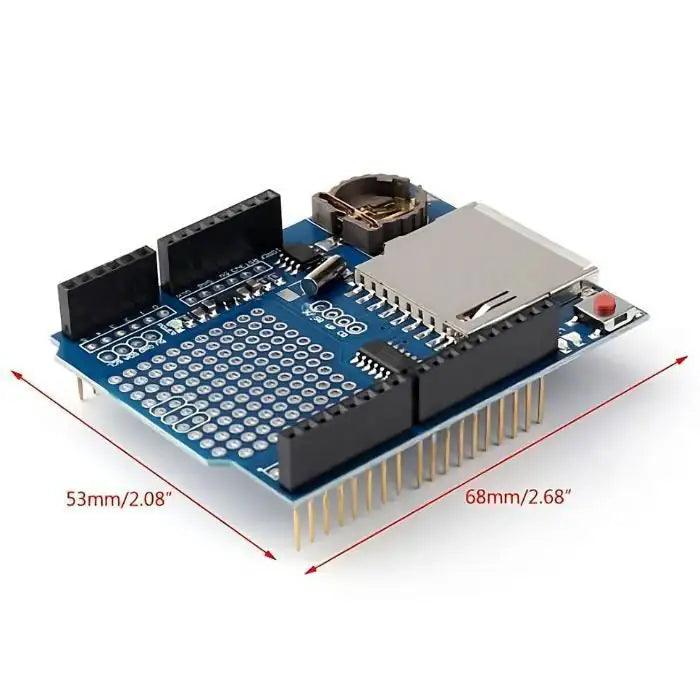
Arduino Data Logger Shield For Uno/Leonardo

SKU: D311HDJLAM
★★★★
4.9 (54 reviews)
The Arduino Data Logger Shield is a practical expansion board designed for recording and storing sensor readings, measurement data, and time-stamped events in Arduino-based projects. The shield combines an SD card storage interface with a Real-Time Clock (RTC) circuit, allowing an Arduino to save large amounts of data while maintaining accurate date and time information. The shield is commonly equipped...
Regular price Rs. 169.00
Regular price Rs. 189.00 Sale price Rs. 169.00
Save Rs. 20 Incl. GST (No Hidden Charges)
Sold out
Tax included. Shipping calculated at checkout.
COD Available
Easy Return
Quality Assured
12 people are viewing this right now
Bulk Orders Available
Special Pricing for Schools, Colleges & Businesses
Contact Us
Free Delivery for all orders above ₹999
Shop for ₹999 or more and get FREE delivery
across India.
FREE
View full product details
Same Day Dispatch Order before 2PM
Pan India Delivery Shipping in 24-48H
Secure Packaging Safe & Damage Free
Dedicated Support Expert Assistance

The Arduino Data Logger Shield is a practical expansion board designed for recording and storing sensor readings, measurement data, and time-stamped events in Arduino-based projects. The shield combines an SD card storage interface with a Real-Time Clock (RTC) circuit, allowing an Arduino to save large amounts of data while maintaining accurate date and time information.

The shield is commonly equipped with a DS1307 Real-Time Clock IC and a backup battery holder, allowing the clock to continue keeping time even when the main Arduino board is powered off. The RTC communicates through the I2C interface, while the SD card uses the SPI interface for high-capacity data storage.

A dedicated SD card slot allows sensor data and system events to be saved in standard file formats such as TXT or CSV, making the recorded information easy to transfer to a computer for analysis. Depending on the shield version, the SD card interface may support standard-size SD cards or MicroSD cards through an onboard socket or adapter arrangement.

The shield also includes a large prototyping area for soldering additional components, sensors, resistors, connectors, or custom circuits. This makes it useful not only for data logging but also for building complete standalone monitoring and measurement systems.

The Arduino Data Logger Shield is ideal for environmental monitoring, weather stations, temperature and humidity recording, energy monitoring, laboratory experiments, agricultural monitoring, equipment usage tracking, and long-term sensor data collection projects.

Key Features

  • Designed for Arduino-based data logging applications
  • Integrated SD card storage interface
  • Built-in Real-Time Clock circuit
  • DS1307 RTC on common shield versions
  • Supports time-stamped data recording
  • RTC backup battery support
  • Clock continues running when main power is disconnected
  • SD card uses SPI communication
  • RTC uses I2C communication
  • Supports TXT and CSV data file creation through software
  • Suitable for long-term sensor data collection
  • Large onboard prototyping area
  • Additional soldering space for custom circuits
  • Status indicator LEDs on common versions
  • Reset button access
  • Direct shield-style mounting
  • Suitable for standalone monitoring projects
  • Compatible with common Arduino libraries
  • Ideal for educational, laboratory, and IoT projects

Shipping & Returns

Orders placed before 3 PM IST will be shipped on the same day (excluding Sundays and Public holidays) through our shipping partners. In rare cases, the pickup may get delayed during Public holidays / Bandh / Environmental disturbances.

Specifications

Specifications:

Module Type: Data Logging Expansion Shield
Primary Function: Data Storage and Time-Stamped Recording
Compatible Platform: Arduino UNO, Arduino Mega and Other Mechanically/Electrically Compatible Boards
Operating Voltage: Typically 5V DC from the Host Arduino Board
RTC IC: DS1307 on Common Versions
RTC Communication Interface: I2C
RTC I2C Address: 0x68
RTC Timekeeping Functions: Seconds, Minutes, Hours, Day, Date, Month and Year
RTC Time Format: 12-Hour or 24-Hour Format
RTC Backup Supply: Coin Cell Battery
Common Backup Battery Type: CR1220 or CR2032, Depending on Shield Version
Data Storage Type: SD Card or MicroSD Card, Depending on Version
SD Card Communication Interface: SPI
Supported File System: FAT16 / FAT32, Depending on Card and Software Configuration
Data File Support: TXT, CSV and Other Software-Defined File Formats
SPI Clock: Controlled by Host Microcontroller
SD Card Chip Select Pin: Commonly Digital Pin 10 on UNO-Style Shields
SPI Pins on Arduino UNO: D11 MOSI, D12 MISO and D13 SCK
I2C Pins on Arduino UNO: A4 SDA and A5 SCL
Logic Level Conversion: Included on Many Shield Versions for SD Card Interface
Prototyping Area: Available
Status LEDs: Available on Common Versions
Reset Button: Available on Common Versions
Mounting Type: Stackable Arduino Shield
Programming Environment: Arduino IDE and Compatible Development Environments
Compatibility: Arduino UNO, Mega and Other Compatible Shield-Header Development Boards

Additional Resources

FAQ

1. What is the Arduino Data Logger Shield used for?

The shield is used to record sensor readings, measurements, and system events onto an SD card. It is commonly used in weather stations, environmental monitoring, temperature logging, energy monitoring, laboratory experiments, and long-term data collection projects.

2. Does the Arduino Data Logger Shield include a Real-Time Clock?

Yes. Common versions include a DS1307 Real-Time Clock that provides date and time information for adding timestamps to recorded data.

3. Can the RTC keep time when the Arduino is powered off?

Yes. The RTC uses a backup coin-cell battery, allowing it to continue maintaining the date and time even when the main Arduino power supply is disconnected.

4. What type of files can be stored on the SD card?

The Arduino software can create and store text-based files such as TXT and CSV files. CSV files are especially useful because the recorded data can be easily opened in spreadsheet and data-analysis software.

5. Can sensors be connected directly to the Data Logger Shield?

Yes. Sensors can be connected through available Arduino pins, and many shield versions include a prototyping area where additional components, connectors, and custom sensor circuits can be permanently soldered.

You May Also Like