Skip to product information
1 of 3

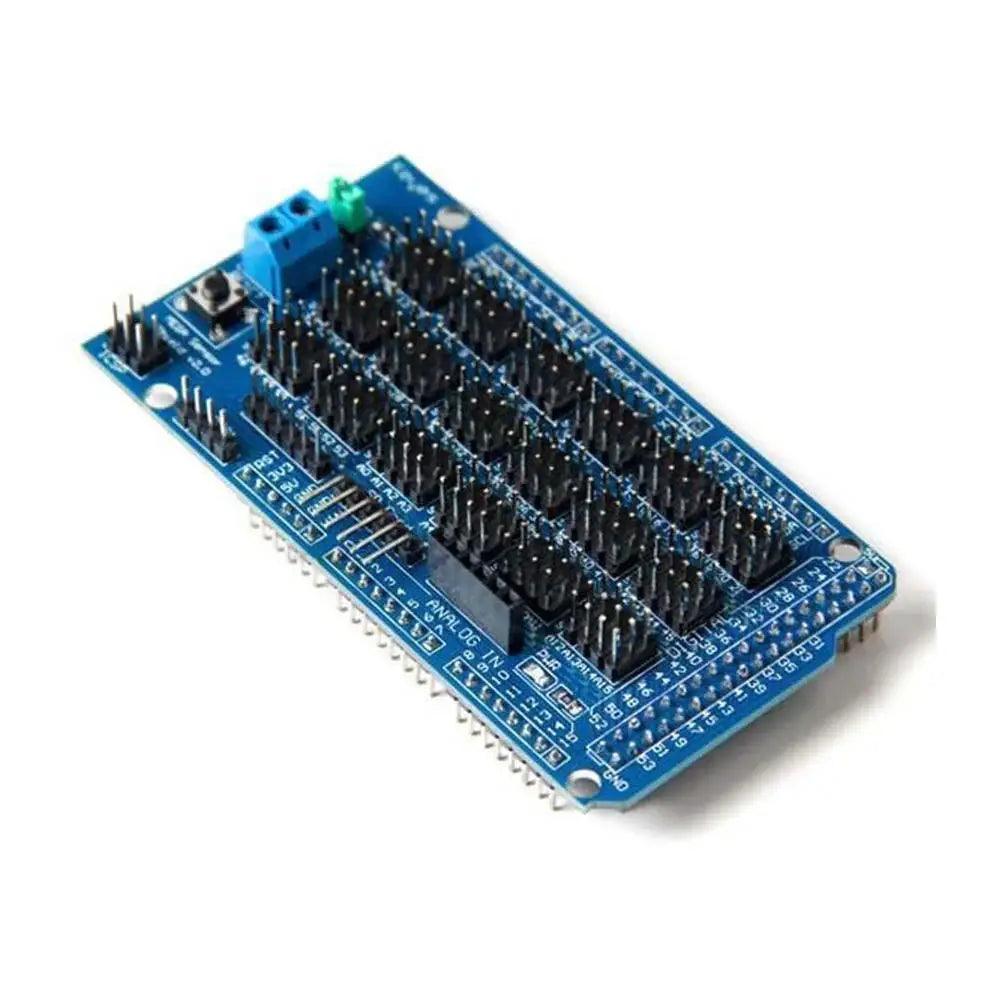
Arduino Mega 2560 R3 Sensor Shield V2.0 compatible

SKU: R8IKPS5IGP
The Arduino Mega offers significantly more I/O capability than a standard Arduino board, featuring 54 digital pins and 16 analog pins. This Sensor Shield is designed specifically for the Mega and includes dedicated connectors for external modules such as an SD card, Bluetooth and other wireless communication modules, APC220 RF modules, and ultrasonic sensors. The shield provides an option to...
Regular price Rs. 179.00
Regular price Rs. 199.00 Sale price Rs. 179.00
Save Rs. 20
Sold out
Tax included. Shipping calculated at checkout.

Shipping & Returns

Orders placed before 3 PM IST will be shipped on the same day (excluding Sundays and Public holidays) through our shipping partners. In rare cases, the pickup may get delayed during Public holidays / Bandh / Environmental disturbances.

Specifications

Specifications:

Compatibility: Designed for Mega boards compatible with Arduino
Dimensions: 10 × 5.4 × 1.8 cm
Weight: 50 grams

Additional Resources

FAQ

1. What is the purpose of Arduino sensor shield?

The intention of an Arduino sensor shield is to streamline the procedure of interconnecting sensors and other input devices to an Arduino microcontroller board. This shield is, in essence, an extension board that fits on top of the Arduino and provides a sequence of input connectors for a variety of sensor types and devices.

By utilizing a sensor shield, you can circumvent the need to manually connect sensors and devices directly to the Arduino's input pins, which can consume a significant amount of time and be prone to error. Instead, you only need to plug the sensors and devices into the appropriate connectors on the shield, and the shield manages the connection to the Arduino.

Sensor shields generally offer an array of input connectors, including analog inputs for sensors that provide uninterrupted voltage readings, digital inputs for sensors that provide distinct on/off signals, and connectors for other categories of devices such as buttons, switches, and relays.

2. Why is it called Arduino Shield?

The term "Arduino shield" refers to an expansion board that can be connected to an Arduino microcontroller board to add additional functionality. The term "shield" comes from the fact that the expansion board is designed to fit on top of the Arduino board, like a shield, and connect to the Arduino's input/output pins.

The concept of using expansion boards to add functionality to a base board is not unique to Arduino. In fact, expansion boards for microcontrollers have been around for many years and are commonly referred to as "daughter boards" or "mezzanine boards."

However, the term "Arduino shield" has become widely used to refer specifically to expansion boards that are designed to work with Arduino boards and follow the Arduino form factor and pin layout. Arduino shields are often designed to work with specific types of sensors or devices, and they typically include connectors, headers, or other interface components that make it easy to connect the shield to the Arduino.

3. What is the Arduino Mega 2560 R3 Sensor Shield V2.0?

It is an expansion board designed for the Arduino Mega 2560 R3 that extends all digital and analog pins into easy-to-use 3-pin headers (Signal, VCC, GND), making it simple to connect sensors, servos, and modules without complex wiring.

4. Which boards is it compatible with?

It is specifically designed for the Arduino Mega 2560 R3 and compatible Mega 2560 boards with the same pin layout.

5. Can I connect servo motors directly?

Yes. All digital pins are available in 3-pin (S/V/G) format, making it easy to connect servo motors. For multiple servos, an external power supply is recommended.

View full product details

The Arduino Mega offers significantly more I/O capability than a standard Arduino board, featuring 54 digital pins and 16 analog pins. This Sensor Shield is designed specifically for the Mega and includes dedicated connectors for external modules such as an SD card, Bluetooth and other wireless communication modules, APC220 RF modules, and ultrasonic sensors.

The shield provides an option to power the “V” pins of all digital 3-pin headers either from the Arduino’s +5V supply or from an external power source.

  • Jumper ON: +5V is supplied from the Arduino (recommended current limit around 300mA).

  • Jumper OFF: +5V (or another suitable voltage) is supplied via an external power source connected to the blue terminal block. In this case, the external ground must also be connected to the terminal block.

This feature is especially useful when driving multiple servos or high-current devices. The analog 3-pin headers continue to use the Arduino’s +5V supply, which helps reduce electrical noise for more stable sensor readings.

The Arduino Mega 2560 R3 Sensor Shield V2.0 features high-quality PCB Immersion Gold processing for improved durability and reliable connections. All digital and analog interfaces are neatly extended, making it easy to connect servo motors, Bluetooth modules, SD card modules, APC220 RF modules, and RB URF v1.1 ultrasonic sensors.

Designed with beginners in mind, this expansion board eliminates complicated wiring. Each sensor connects using a standard 3-pin cable (compatible with both digital and analog interfaces). Simply connect the module, upload the program to the Mega controller, and start reading sensor data or receiving wireless communication data to create interactive projects easily.

Key Features:

  • High-quality Immersion Gold PCB finish

  • Clearly labeled 3-pin interfaces for sensors and modules

  • External power support for high-current devices

  • Organized and simplified wiring system

Applications:

The shield can be connected to a wide range of modules, including:

  • Sensors

  • Relay modules

  • Buttons and switches

  • Wireless communication modules

  • Servo motors and other actuators

It is ideal for robotics, automation systems, and interactive electronics projects.