Skip to product information
1 of 4

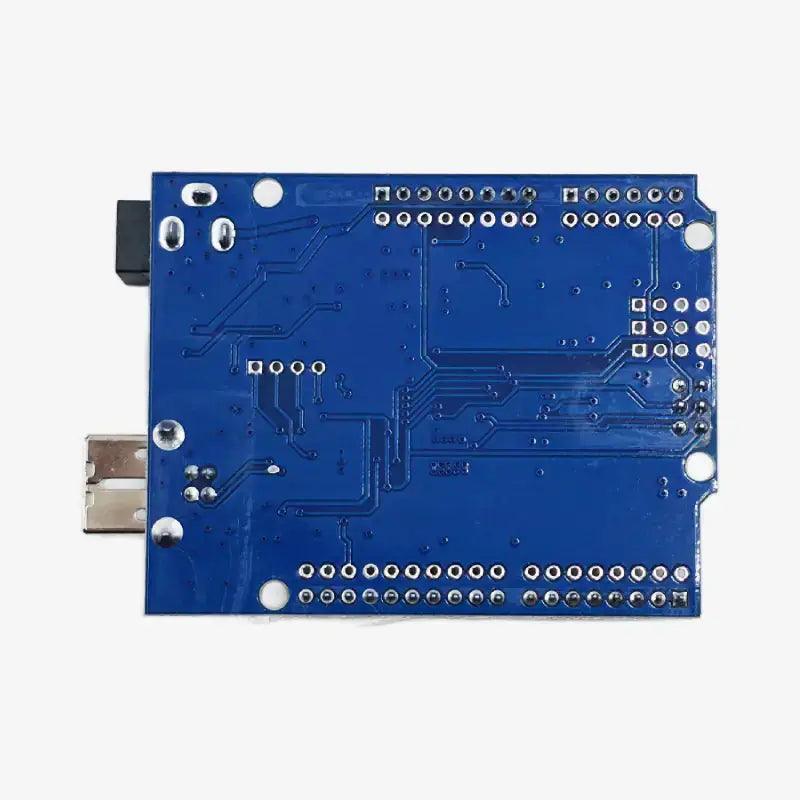
Arduino Uno R3 CH340G Development compatible Board with Micro USB port

SKU: 6YEDIMAFD3
The Arduino Uno R3 CH340G ATmega328P Development Board is a budget-friendly alternative to the original Arduino Uno R3. It offers the same core functionality and performance as the standard Uno, but at a more affordable price. The main difference lies in the USB-to-serial interface: instead of the ATmega16U2 chip used in the official version, this board uses the CH340G USB-to-Serial...
Regular price Rs. 299.00
Regular price Rs. 349.00 Sale price Rs. 299.00
Save Rs. 50
Sold out
Tax included. Shipping calculated at checkout.

Shipping & Returns

Orders placed before 3 PM IST will be shipped on the same day (excluding Sundays and Public holidays) through our shipping partners. In rare cases, the pickup may get delayed during Public holidays / Bandh / Environmental disturbances.

Specifications

Specifications:

Microcontroller: ATmega328P
Input Voltage: 7V – 12V (Recommended)
Operating Voltage: 5V
Digital I/O Pins: 14 (6 Pins support PWM output)
Analog Input Pins: 6
Flash Memory: 32KB (0.5KB used by bootloader)
SRAM: 2KB
EEPROM: 1KB
Clock Speed: 16MHz
USB Interface: USB-to-Serial Converter
Communication Protocols: UART, SPI, I2C
DC Current per I/O Pin: 20mA
DC Current for 3.3V Pin: 50mA
Power Supply: USB or External Adapter
Reset Button: Yes
Onboard Voltage Regulator: Yes
Dimensions: 7.5 × 5.4 × 1.2 cm
Weight: 26 grams

Additional Resources

FAQ

1. What is the difference between CH340C and CH340G?

CH340C and CH340G are both USB-to-Serial converter chips widely used in development boards and embedded systems. The primary difference between them lies in their packaging and hardware design.

The CH340G comes in a 16-pin DIP (through-hole) package, making it easier to solder and commonly used in Arduino-compatible boards. The CH340C, on the other hand, is available in a 16-pin SSOP (surface-mount) package, which is more suitable for compact and space-saving PCB designs.

Functionally, both chips perform the same task of converting USB signals to serial (UART) communication, allowing microcontrollers to communicate with a computer. However, the CH340C includes a built-in crystal oscillator, eliminating the need for an external crystal, which simplifies PCB design and reduces component count.

2. Is Arduino Uno CH340 compatible with Arduino?

Yes, the Arduino Uno CH340 board is fully compatible with the standard Arduino Uno R3. It is essentially a cost-effective alternative that replaces the original ATmega16U2 USB interface chip with the CH340 USB-to-Serial converter.

The board still uses the ATmega328P microcontroller, ensuring compatibility with the Arduino IDE, shields, and libraries. The only additional requirement is installing the CH340 driver on your computer before use. Once the driver is installed, the board works exactly like a standard Arduino Uno.

3. Do I need to install drivers for the CH340-based Arduino?

Yes, in most cases, you need to install the CH340 driver for your operating system before the board can be recognized by your computer. After installing the driver, a new COM port will appear in the Arduino IDE under the “Tools > Port” menu. Once selected, you can upload sketches normally.

Some operating systems may automatically install the driver, but manual installation is often required, especially on Windows systems.

4. Does the CH340 affect the performance of the Arduino board?

No, the CH340 chip does not affect the processing performance of the Arduino board. It is only responsible for USB-to-serial communication during programming and serial monitoring.

Once your code is uploaded, the ATmega328P microcontroller handles all operations independently. The overall functionality, speed, and capability of the board remain the same as the official Arduino Uno R3.

View full product details

The Arduino Uno R3 CH340G ATmega328P Development Board is a budget-friendly alternative to the original Arduino Uno R3. It offers the same core functionality and performance as the standard Uno, but at a more affordable price. The main difference lies in the USB-to-serial interface: instead of the ATmega16U2 chip used in the official version, this board uses the CH340G USB-to-Serial converter.

Despite the difference in the USB interface chip, the board performs just as reliably in practical applications. The CH340G chip is primarily used for uploading sketches and handling serial communication through the Micro-USB port. Once your program is uploaded, the board operates exactly like a standard Arduino Uno R3. In day-to-day use, there is virtually no difference in functionality, compatibility, or performance compared to the more expensive official version.

This development board is built around the ATmega328P microcontroller, making it fully compatible with the Arduino IDE, libraries, and most Arduino shields and accessories. It is suitable for beginners, students, hobbyists, and professionals working on embedded systems, robotics, automation, and IoT projects.

Key Improvements Over the Older Version

• Dual rows of header holes (male and female style), allowing easy connection with standard female jumper wires.
• Three additional rows of header holes for more convenient wiring and expanded connectivity.
• The ATmega328P is provided in a flat (SMD) package instead of the traditional DIP socket package.
• The ATmega16U2 USB interface has been replaced with the more cost-effective CH340G USB-to-Serial converter.

Overall, the Arduino Uno R3 CH340G board provides the same development experience as the classic Uno while offering a more economical solution for prototyping, education, and large-scale project deployments.