Multifunctional Expansion Board For Arduino UNO/Leonardo

SKU: KPTHYYSSJ7
★★★★
4.5 (102 reviews)
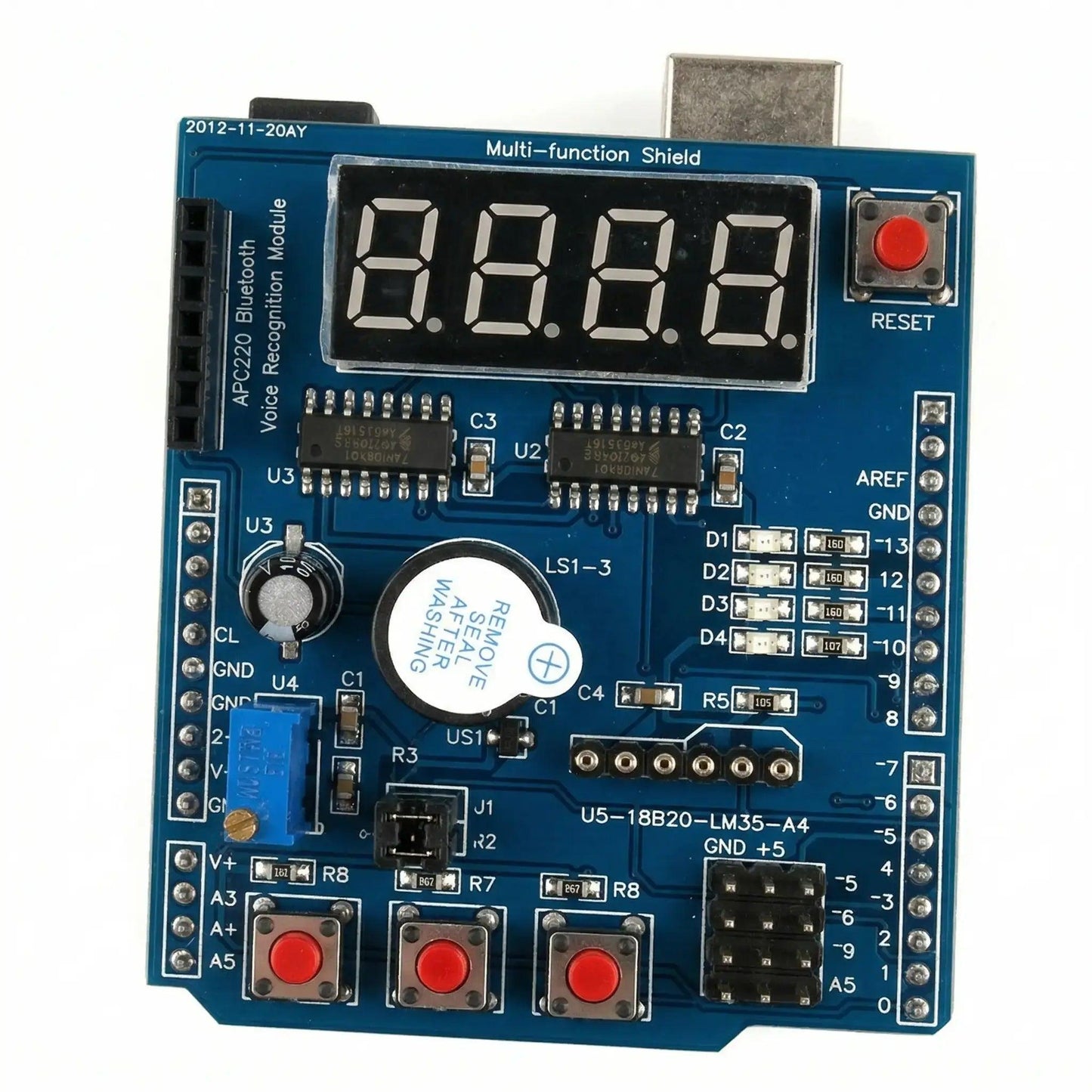
The Multifunction Shield for Arduino Uno / Leonardo is an all-in-one learning and prototyping expansion board designed to simplify electronics experiments and microcontroller projects. The shield integrates several commonly used input, output, display, sound, and sensor-interface components onto a single PCB, reducing the need for separate breadboards, modules, and complex jumper-wire connections. The shield includes a 4-digit 7-segment LED display,...
Regular price Rs. 149.00
Regular price Rs. 155.00 Sale price Rs. 149.00
Save Rs. 6 Incl. GST (No Hidden Charges)
Sold out
Tax included. Shipping calculated at checkout.
COD Available
Easy Return
Quality Assured
12 people are viewing this right now
Bulk Orders Available
Special Pricing for Schools, Colleges & Businesses
Contact Us
Free Delivery For All Prepaid Orders Above ₹999
Shop for ₹999 or more and get FREE delivery
across India.
FREE
View full product details
Same Day Dispatch Order before 2PM
Pan India Delivery Shipping in 24-48H
Secure Packaging Safe & Damage Free
Dedicated Support Expert Assistance

The Multifunction Shield for Arduino Uno / Leonardo is an all-in-one learning and prototyping expansion board designed to simplify electronics experiments and microcontroller projects. The shield integrates several commonly used input, output, display, sound, and sensor-interface components onto a single PCB, reducing the need for separate breadboards, modules, and complex jumper-wire connections.

The shield includes a 4-digit 7-segment LED display, four indicator LEDs, three push buttons, an adjustable 10kΩ potentiometer, and a piezo buzzer. It also provides dedicated interfaces for temperature sensors, an infrared receiver, servo motors, and serial communication modules. The 4-digit display is driven through 74HC595 shift registers, reducing the number of microcontroller pins required for display control.

Designed primarily for boards with compatible shield headers, the module can be mounted directly onto Arduino Uno and Leonardo-style boards. It is suitable for learning digital input/output, analog signal reading, display control, button interfacing, sound generation, temperature sensing, infrared communication, and servo control.

The Multifunction Shield is ideal for students, beginners, hobbyists, robotics learners, and developers who want a convenient platform for testing multiple functions without assembling a separate circuit for every experiment.

Key Features

  • All-in-one Arduino learning and prototyping shield
  • Compatible with Arduino Uno and Leonardo-style shield headers
  • Integrated 4-digit 7-segment LED display
  • Display controlled through 74HC595 shift registers
  • Four onboard LED indicators
  • Three independent push buttons
  • Integrated adjustable 10kΩ potentiometer
  • Onboard piezo buzzer
  • Dedicated LM35 temperature sensor interface
  • Dedicated DS18B20 temperature sensor interface
  • Infrared receiver interface
  • Servo motor connection interface
  • Serial communication expansion header
  • Suitable for Bluetooth and other serial modules
  • Direct shield-style installation
  • Reduces external wiring and breadboard requirements
  • Suitable for beginners and electronics education
  • Supports multiple experiments on a single board
  • Compact and reusable development platform

Shipping & Returns

Orders placed before 3 PM IST will be shipped on the same day (excluding Sundays and Public holidays) through our shipping partners. In rare cases, the pickup may get delayed during Public holidays / Bandh / Environmental disturbances.

Specifications

Specifications:

Module Type: Multifunction Learning and Prototyping Shield
Compatible Platform: Arduino Uno / Leonardo and Compatible Shield-Header Boards
Operating Voltage: 5V DC from Compatible Controller Board
Display Type: 4-Digit 7-Segment LED Display
Display Driver: 74HC595 Shift Registers
Number of Indicator LEDs: 4
Number of User Push Buttons: 3
Additional Reset Button: Available on Common Versions
Potentiometer Value: 10kΩ
Potentiometer Type: Adjustable Precision Potentiometer
Audio Output: Piezo Buzzer
Temperature Sensor Interface: LM35
Digital Temperature Sensor Interface: DS18B20
Infrared Receiver Interface: Available
Servo Interface: Available on Common Versions
Serial Expansion Interface: Available
Communication Module Support: Bluetooth, Wireless Serial, Voice and Other Compatible Serial Modules
Mounting Type: Stackable Shield Header
Typical Dimensions: Approximately 69mm × 54mm × 11mm
Typical Weight: Approximately 27g
PCB Type: Multifunction Expansion Shield
Programming Platform: Arduino IDE and Compatible Development Environments.

FAQ

1. What is the Multifunction Shield for Arduino Uno / Leonardo used for?

The shield is used for electronics learning, prototyping, and microcontroller experiments. It allows users to work with displays, LEDs, buttons, analog inputs, buzzers, temperature sensors, servo motors, and communication modules without building a separate circuit for each experiment.

2. What components are included on the Multifunction Shield?

Common versions include a 4-digit 7-segment display, four LEDs, three push buttons, a 10kΩ adjustable potentiometer, a piezo buzzer, and interfaces for LM35, DS18B20, infrared receivers, servo motors, and serial communication modules.

3. Can the Multifunction Shield be mounted directly on an Arduino Uno?

Yes. The shield is designed to plug directly into compatible Arduino Uno-style headers, allowing the onboard components to connect to the controller pins without separate jumper wiring.

4. Can the Multifunction Shield be used for temperature measurement?

Yes. Common versions provide interfaces for LM35 analog temperature sensors and DS18B20 digital temperature sensors. The required sensor may need to be installed separately depending on the shield package.

5. Is the Multifunction Shield suitable for beginners?

Yes. The shield is particularly useful for beginners and students because it combines several commonly used electronic components on one board, making it easier to learn programming, digital input/output, analog sensing, displays, alarms, and basic automation.

You May Also Like