Skip to product information
1 of 4

D1(ESP-12E) WiFi Development Board

SKU: D6Y51X3U58
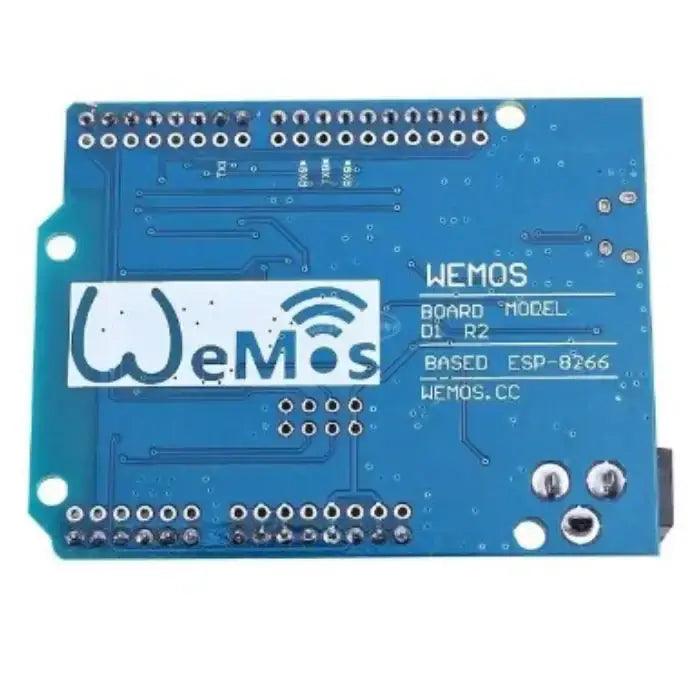
The ESP8266 D1 R1 V2.1.0 is a powerful WiFi-enabled development board designed in the familiar Arduino UNO form factor. It combines the flexibility of the ESP8266 WiFi module with the ease of use of the Arduino layout, making it ideal for IoT, home automation, and wireless communication projects. The board operates at 3.3V and is built around the ESP8266EX chip,...
Regular price Rs. 329.00
Regular price Rs. 369.00 Sale price Rs. 329.00
Save Rs. 40
Sold out
Tax included. Shipping calculated at checkout.

Shipping & Returns

Orders placed before 3 PM IST will be shipped on the same day (excluding Sundays and Public holidays) through our shipping partners. In rare cases, the pickup may get delayed during Public holidays / Bandh / Environmental disturbances.

Specifications

Specifications:

Microcontroller: ESP8266EX
Board Type: WiFi Development Board
Operating Voltage: 3.3V
Digital I/O Pins: 11 (All pins support Interrupt, PWM, I2C, except D0)
Analog Input Pins: 1
Flash Memory: 4Mb
nput Voltage Range: 9V to 12V
Maximum Output: 5V at up to 1A
Dimensions: 5 × 4 × 3 cm
Weight: 25 grams

Additional Resources

FAQ

1. What is the ESP-12E WiFi Module?

The ESP-12E is a compact WiFi module designed to provide wireless connectivity to microcontrollers and embedded systems. It is built around the ESP8266EX, a highly integrated WiFi System-on-Chip (SoC). This module allows devices to connect to wireless networks and enables internet-based communication for IoT applications.

The ESP-12E includes an internal 32-bit processor capable of handling multiple communication protocols and generating control signals. It can either be used as a WiFi add-on for existing microcontrollers or operate independently for certain standalone applications. Due to its built-in processing power and wireless capability, it is often considered a WiFi-enabled alternative to traditional development boards like Arduino in many IoT projects.

2. What is the difference between ESP-12E and ESP8266EX?

The ESP8266EX is the actual WiFi System-on-Chip (SoC) that contains the processor, WiFi stack, and core functionality. The ESP-12E, on the other hand, is a complete module that is built around the ESP8266EX chip.

In simple terms, ESP8266EX is the chip, while ESP-12E is the ready-to-use module that includes the chip along with additional components such as flash memory, antenna, and supporting circuitry.

Compared to earlier versions like ESP-07 and ESP-12, the ESP-12E exposes more GPIO pins for external use. The ESP-12F is a further improved version of the ESP-12E, featuring optimized peripheral circuitry and an enhanced PCB design for better performance and stability.

3. Is ESP-12E a microcontroller?

The ESP-12E is primarily a WiFi module designed to add wireless connectivity to electronic systems. While it contains the ESP8266EX chip, which includes a built-in 32-bit microcontroller core, the ESP-12E itself is not classified as a standalone microcontroller board.

However, thanks to its internal processing capability, it can run programs independently without requiring an external microcontroller in many applications. In summary, the ESP-12E is a WiFi module with integrated microcontroller functionality, but it is generally described as a communication module rather than a dedicated microcontroller board.

View full product details

The ESP8266 D1 R1 V2.1.0 is a powerful WiFi-enabled development board designed in the familiar Arduino UNO form factor. It combines the flexibility of the ESP8266 WiFi module with the ease of use of the Arduino layout, making it ideal for IoT, home automation, and wireless communication projects. The board operates at 3.3V and is built around the ESP8266EX chip, a high-performance 32-bit microcontroller with integrated WiFi capability.

Unlike traditional Arduino boards, the D1 R1 features significantly larger flash memory, allowing you to develop more advanced applications such as web servers, cloud-connected devices, and real-time data monitoring systems. The board provides 11 digital I/O pins and 1 analog input pin, offering sufficient connectivity for sensors, relays, displays, and other peripherals.

The ESP8266 D1 R1 can be easily programmed using the Arduino IDE, making it beginner-friendly while still powerful enough for advanced users. It is also compatible with NodeMCU firmware for those who prefer Lua-based development. The board connects to a computer via a Micro-USB (Micro-B) cable for programming and power.

One of its key advantages is the onboard switching power supply, which allows the board to be powered using an external supply of up to 12V. This makes it suitable for standalone installations where USB power may not be available.

Overall, the ESP8266 D1 R1 is an excellent choice for developers looking to build WiFi-enabled embedded systems while maintaining compatibility with the Arduino ecosystem.