Skip to product information
1 of 4

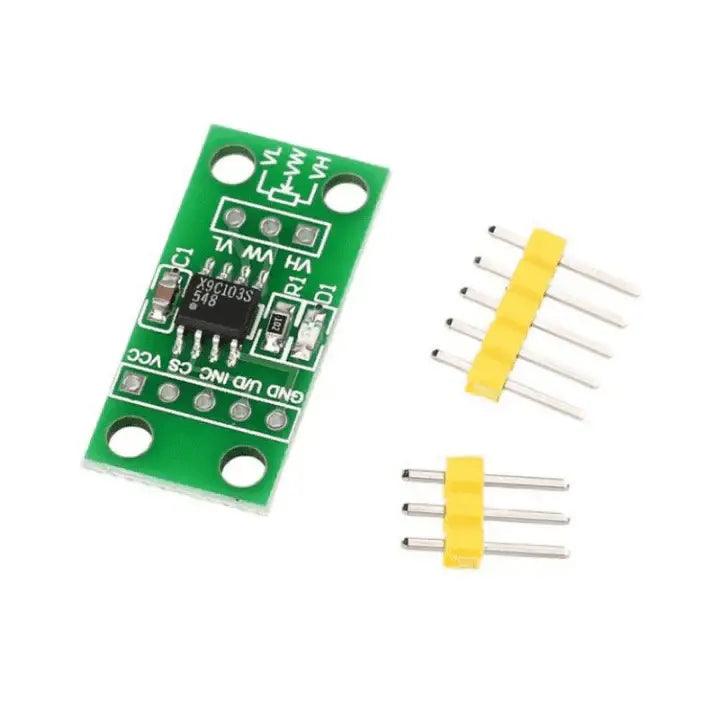
Digital Potentiometer Board Module

SKU: SH01W1J3DU
The X9C103S Digital Potentiometer Board Module is a compact, microcontroller-compatible module designed to operate within a 3V–5V DC range, making it suitable for platforms like Arduino. The X9C103 is a digitally controlled potentiometer (XDCP) that integrates a resistor array, wiper switch, control logic, and non-volatile memory. It features a 3-wire interface for controlling the wiper position. Internally, the potentiometer consists...
Regular price Rs. 279.00
Regular price Rs. 359.00 Sale price Rs. 279.00
Save Rs. 80
Sold out
Tax included. Shipping calculated at checkout.

Shipping & Returns

Orders placed before 3 PM IST will be shipped on the same day (excluding Sundays and Public holidays) through our shipping partners. In rare cases, the pickup may get delayed during Public holidays / Bandh / Environmental disturbances.

Specifications

Specifications:

IC Chip: X9C103S
Input Supply Voltage: 3V – 5V DC
Dimensions: 3 Ɨ 2 Ɨ 1 cm
Weight: 5 grams

FAQ

1. What is a digital potentiometer board module?

A digital potentiometer module is an electronic device that provides variable resistance controlled digitally (via microcontrollers) instead of manual rotation like a traditional potentiometer.

2. How does a digital potentiometer work?

It uses an internal resistor network and electronic switches. A microcontroller communicates with it (usually via I2C or SPI) to adjust the resistance value step-by-step.

3. What are the advantages of a digital potentiometer over a manual one?

It offers precise, repeatable control, remote adjustment, programmability, and eliminates the need for physical tuning.

4. Where is a digital potentiometer commonly used?

It is widely used in audio volume control, programmable gain circuits, calibration systems, and microcontroller-based applications like Arduino and embedded systems.

5. What should be considered when selecting a digital potentiometer module?

Important factors include resistance range, resolution (number of steps), communication protocol (I2C/SPI), operating voltage, and compatibility with your microcontroller.

View full product details

The X9C103S Digital Potentiometer Board Module is a compact, microcontroller-compatible module designed to operate within a 3V–5V DC range, making it suitable for platforms like Arduino. The X9C103 is a digitally controlled potentiometer (XDCP) that integrates a resistor array, wiper switch, control logic, and non-volatile memory.

It features a 3-wire interface for controlling the wiper position. Internally, the potentiometer consists of 99 resistive elements connected in series, forming multiple tap points. The wiper position is adjusted using control inputs such as CS (Chip Select), U/D (Up/Down), and INC (Increment). The selected position can be stored in non-volatile memory, allowing the device to retain its last setting even after power is turned off and restore it upon restart.

The module is divided into three main sections:

  • Input Control Section: Functions like an up/down counter to control resistance
  • Counter & Decoding Section: Selects the appropriate tap point on the resistor array
  • Non-Volatile Memory: Stores the last wiper position for future use

The resistor array includes 99 individual resistors with electronic switches at each tap point, enabling precise control. The wiper behaves similarly to a mechanical potentiometer but does not move beyond its limits, ensuring stable operation. It uses a make-before-break switching mechanism, meaning multiple connections may briefly occur during transitions, which can momentarily lower the resistance.

An internal charge pump allows operation across a wider voltage range (approximately -5V to +5V at the terminals), while maintaining a single supply. However, a small noise level (around 20 mV at 850 kHz) should be considered during circuit design.

The module is often provided with sample C language code, structured into modules such as main functions, display handling, and button control. This code can be explored using tools like KEIL for learning and testing purposes. The VL and VH pins correspond to the low and high ends of the potentiometer, supporting an input voltage range from -5V to +5V.