Skip to product information
1 of 3

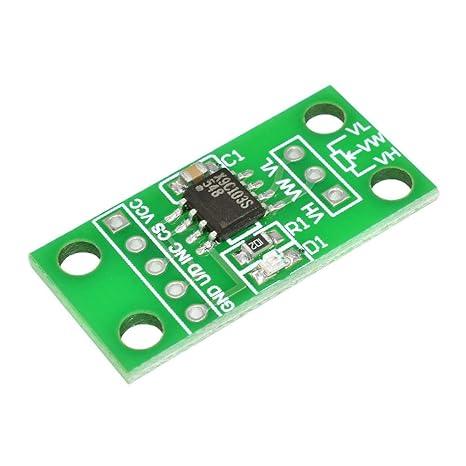
Digital Potentiometer Board Module X9C103S

SKU: RZ0QEOZVYY
The X9C103S Digital Potentiometer Board Module is an electronically controlled variable resistor that allows resistance adjustment through digital signals instead of a mechanical knob. Based on the X9C103S digital potentiometer IC, the module provides a total resistance of 10kΩ with 100 programmable wiper positions, enabling precise and repeatable resistance control. The module features non-volatile memory, which stores the last wiper...
Regular price Rs. 220.00
Regular price Rs. 249.00 Sale price Rs. 220.00
Save Rs. 29
Sold out
Tax included. Shipping calculated at checkout.

Shipping & Returns

Orders placed before 3 PM IST will be shipped on the same day (excluding Sundays and Public holidays) through our shipping partners. In rare cases, the pickup may get delayed during Public holidays / Bandh / Environmental disturbances.

Specifications

Specifications:

Module Type: Digital Potentiometer Board
IC Used: X9C103S
Total Resistance: 10kΩ
Resolution: 100 Steps (100 Tap Points)
Wiper Resistance: Typically 40Ω
Operating Voltage: 3V – 5V DC
Control Interface: CS, INC, U/D
Memory Type: Non-Volatile Memory
Wiper Position Storage: Yes
End Terminal Voltage Range: -5V to +5V
Current Capability: Up to 4.4mA (typical)
PCB Dimensions: Approximately 27mm × 13mm
Mounting Type: Through-Hole Module
Compatible Platforms: Arduino, ESP32, STM32, Raspberry Pi, PIC, AVR
Operating Temperature: -40°C to +85°C (typical)

Additional Resources

FAQ

1. What is the X9C103S Digital Potentiometer Board Module used for?

It is used to electronically adjust resistance values in circuits, making it suitable for applications such as volume control, sensor calibration, LCD contrast adjustment, and programmable power supplies.

2. What is the resistance value of the X9C103S module?

The X9C103S provides a total resistance of 10kΩ with 100 programmable adjustment steps for precise resistance control.

3. Does the X9C103S retain its settings after power is turned off?

Yes, the module features non-volatile memory that stores the last wiper position, allowing it to retain settings even when power is removed.

4. Can the X9C103S module be controlled by Arduino and other microcontrollers?

Yes, it can be easily interfaced with Arduino, ESP32, STM32, Raspberry Pi Pico, and other microcontrollers using digital control signals.

5. What are the advantages of a digital potentiometer over a mechanical potentiometer?

A digital potentiometer offers precise electronic control, programmable adjustment, remote operation, and eliminates the mechanical wear associated with traditional potentiometers.

View full product details

The X9C103S Digital Potentiometer Board Module is an electronically controlled variable resistor that allows resistance adjustment through digital signals instead of a mechanical knob. Based on the X9C103S digital potentiometer IC, the module provides a total resistance of 10kΩ with 100 programmable wiper positions, enabling precise and repeatable resistance control.

The module features non-volatile memory, which stores the last wiper position even after power is removed, making it ideal for applications requiring retained settings. It can be controlled by microcontrollers such as Arduino, ESP32, STM32, and Raspberry Pi Pico using a simple control interface.

This digital potentiometer is widely used in audio control, programmable power supplies, sensor calibration, LCD contrast adjustment, and automated electronic systems where manual potentiometers need to be replaced with software-controlled resistance adjustment.

Key Features

  • Based on the X9C103S digital potentiometer IC
  • 10kΩ total resistance range
  • 100 programmable resistance steps
  • Non-volatile memory retains settings after power-off
  • Can function as a potentiometer or variable resistor
  • Simple digital control interface (CS, INC, U/D)
  • Operating voltage range of 3V–5V
  • Compatible with Arduino, ESP32, STM32, Raspberry Pi, and other microcontrollers
  • No mechanical wear associated with traditional potentiometers
  • Compact PCB module for easy prototyping and integration