
Couldn't load pickup availability
Orders placed before 3 PM IST will be shipped on the same day (excluding Sundays and Public holidays) through our shipping partners. In rare cases, the pickup may get delayed during Public holidays / Bandh / Environmental disturbances.


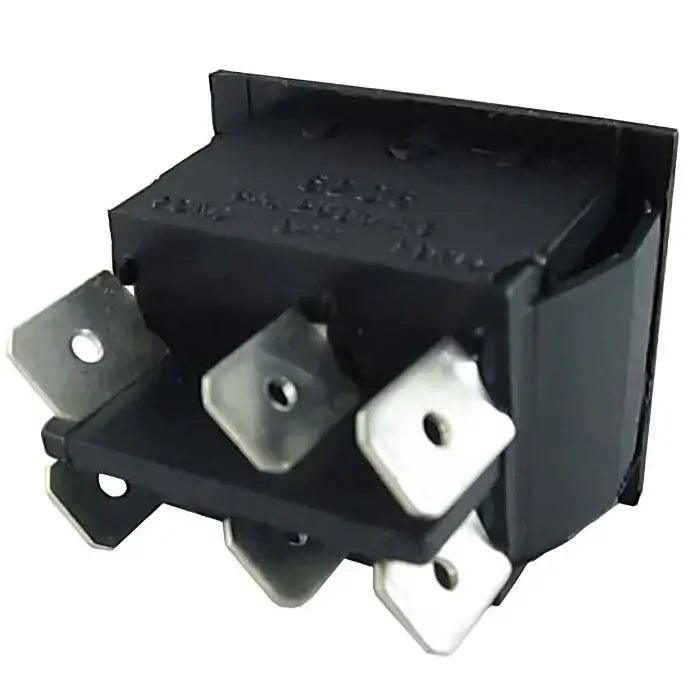
A DPDT (Double Pole Double Throw) switch is an electromechanical switch that features two inputs and four outputs, where each input can connect to one of two outputs. It can be easily understood as two SPDT switches combined into one, with both operated simultaneously by a single actuator.
One of the most common uses of a DPDT switch is polarity or phase reversal. This is typically achieved by wiring the terminals in a criss-cross configuration. In this setup, the top terminals act as inputs, while the middle terminals serve as outputs.
For example, if we label the terminals as X (pin 1), Z (pin 2), Y (pin 5), and W (pin 6), connections are made such that W is linked to Y and X is linked to Z. When the switch is in one position, the input and output are directly connected, maintaining the original polarity. When toggled to the other position, the internal connections reverse, causing the polarity to flip. This allows, for instance, a motor to change its direction with a single switch action.
The switch is also designed for easy installation, featuring a snap-in locking mechanism that allows it to be securely mounted into panels or enclosures without the need for screws or nuts and bolts.
To use this switch in projects, you may require basic components such as DC motors, batteries or power supplies, BO motors, wires, and connectors. It is widely used in robotics, automation systems, and other electronic applications where directional control is required.


