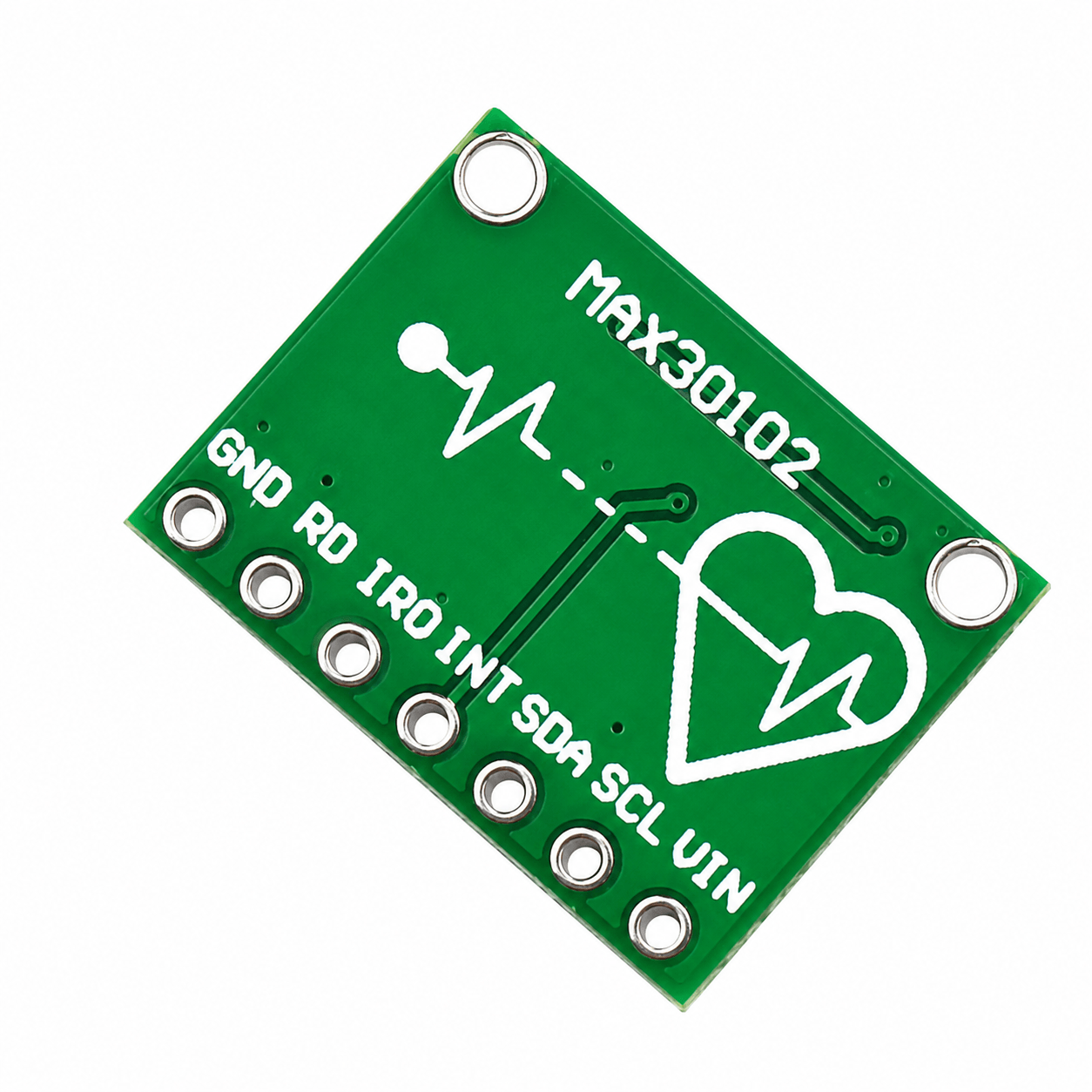
Heart Rate Oxygen Pulse Sensor - MAX30100/30102

SKU: EP1YP6XZ17
★★★★
4.7 (84 reviews)
The Heart Rate Oxygen Pulse Sensor – MAX30100/30102 is a compact optical biosensor module designed for measuring heart rate (pulse rate) and estimating blood oxygen saturation (SpO₂) in wearable, fitness, educational, and experimental monitoring projects. Depending on the supplied module variant, it is based on either the MAX30100 or MAX30102 integrated pulse oximetry and heart-rate sensor IC. The sensor uses...
Regular price Rs. 129.00
Regular price Rs. 135.00 Sale price Rs. 129.00
Save Rs. 6
Sold out
Tax included. Shipping calculated at checkout.
COD Available
Easy Return
Quality Assured
12 people are viewing this right now
For Bulk Order Contact Us View full product details
Same Day Dispatch Order before 2PM
Pan India Delivery Shipping in 24-48H
Secure Packaging Safe & Damage Free
Dedicated Support Expert Assistance

The Heart Rate Oxygen Pulse Sensor – MAX30100/30102 is a compact optical biosensor module designed for measuring heart rate (pulse rate) and estimating blood oxygen saturation (SpO₂) in wearable, fitness, educational, and experimental monitoring projects. Depending on the supplied module variant, it is based on either the MAX30100 or MAX30102 integrated pulse oximetry and heart-rate sensor IC.

The sensor uses red and infrared LEDs, a sensitive photodetector, optical elements, and low-noise signal-processing circuitry. Light emitted into the fingertip or other suitable tissue is reflected back toward the photodetector. Changes in the reflected optical signal caused by pulsating blood flow are processed using photoplethysmography (PPG) techniques to calculate heart rate and estimate oxygen saturation.

The module communicates with a microcontroller through the I2C digital interface, requiring only SDA and SCL communication lines. The MAX30100 and MAX30102 both integrate optical components and low-noise electronics, while the newer MAX30102 provides features such as a high-resolution ADC, programmable sampling rates, improved signal performance, and a deeper FIFO architecture.

The module is commonly used with Arduino, ESP32, STM32, Raspberry Pi, RP2040, and other I2C-enabled development platforms. It is suitable for wearable prototypes, fitness monitoring devices, pulse-rate displays, sleep-monitoring experiments, IoT projects, and educational biomedical electronics applications.

Key Features

  • Measures heart rate and pulse waveform
  • Supports blood oxygen saturation (SpO₂) estimation
  • Available with MAX30100 or MAX30102 sensor IC
  • Optical PPG-based sensing technology
  • Integrated red and infrared LEDs
  • Integrated photodetector
  • Built-in low-noise analog front-end
  • Ambient light rejection circuitry
  • Digital I2C communication interface
  • Programmable LED current
  • Programmable sampling configuration
  • Low-power operation
  • Software shutdown mode
  • Compact PCB module design
  • Suitable for wearable and portable projects
  • Interrupt output for efficient data handling
  • Compatible with popular microcontrollers and development boards

Shipping & Returns

Orders placed before 3 PM IST will be shipped on the same day (excluding Sundays and Public holidays) through our shipping partners. In rare cases, the pickup may get delayed during Public holidays / Bandh / Environmental disturbances.

Specifications

Specifications:

Module Type: Optical Heart Rate and Pulse Oximeter Sensor Module
Sensor IC: MAX30100 or MAX30102, Depending on Module Variant
Measurement Parameters: Heart Rate and Estimated SpO₂
Sensing Method: Reflective Photoplethysmography (PPG)
Optical Sources: Red LED and Infrared LED
Detector Type: Integrated Photodetector
Communication Interface: I2C
I2C Address: 0x57
Output Type: Digital Sensor Data
Interrupt Output: Available
MAX30100 Sensor Supply: 1.8V Core and 3.3V LED Supply
MAX30102 Sensor Supply: 1.8V Core and Separate LED Supply
Typical Breakout Module Input Voltage: Commonly 3.3V or 5V on regulated breakout versions; module dependent
MAX30100 ADC Resolution: Up to 16-Bit
MAX30102 ADC Resolution: Up to 18-Bit
MAX30100 Sample Rate: 50 to 1000 Samples Per Second
MAX30102 Sample Rate: 50 to 3200 Samples Per Second
Programmable LED Current: Supported
MAX30100 LED Current Range: Up to Approximately 50mA
MAX30102 FIFO Depth: 32 Samples
Software Shutdown Mode: Supported
Typical Shutdown Current: Approximately 0.7µA
Operating Temperature Range: -40°C to +85°C
Compatibility: Arduino UNO, Nano, Mega, ESP32, ESP8266, STM32, Raspberry Pi, RP2040, PIC, AVR and other I2C-compatible controllers.

Additional Resources

FAQ

1. What is the MAX30100/30102 Heart Rate Oxygen Pulse Sensor used for?

The sensor is used for measuring heart rate, monitoring pulse waveforms, and estimating blood oxygen saturation levels in wearable devices, fitness trackers, educational projects, and experimental monitoring systems.

2. How does the MAX30100/30102 sensor measure heart rate and SpO₂?

The sensor uses red and infrared light along with a photodetector. Changes in reflected light caused by pulsating blood flow are processed using photoplethysmography techniques to determine pulse rate and estimate oxygen saturation.

3. Is the MAX30100/30102 sensor compatible with Arduino and ESP32?

Yes. These sensor modules can be used with Arduino, ESP32, STM32, Raspberry Pi, RP2040, and other controllers that support I2C communication.

4. What is the difference between MAX30100 and MAX30102?

Both sensors are designed for heart-rate and pulse-oximetry applications. The MAX30102 is a newer device with improved optical performance, higher ADC resolution, wider sampling-rate options, and enhanced signal acquisition capabilities.

5. Can the MAX30100/30102 module be used as a medical diagnostic device?

Standard development modules and hobby projects based on these sensors should not be treated as certified medical diagnostic devices. Measurement quality depends on sensor placement, motion, ambient light, signal-processing algorithms, calibration, and the overall device design.