Skip to product information
1 of 3

LDR Light Sensor Digital Module

SKU: EZ971IG736
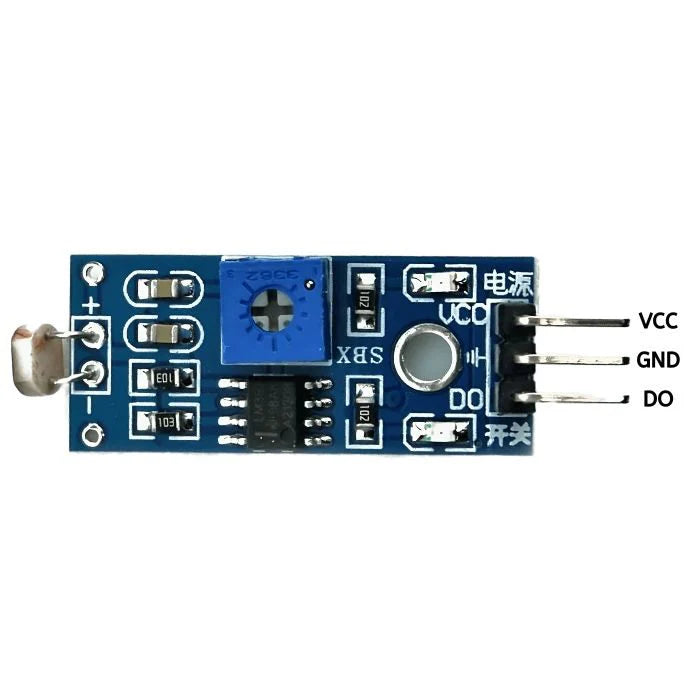
The LDR Light Sensor Digital Module is a compact ambient light detection module that uses a Light Dependent Resistor (LDR) and an LM393 voltage comparator to detect changes in light intensity. Unlike analog LDR modules, this module provides a digital output, making it ideal for applications where a simple light/dark detection signal is required. The onboard potentiometer allows users to...
Regular price Rs. 35.00
Regular price Rs. 39.00 Sale price Rs. 35.00
Save Rs. 4
Sold out
Tax included. Shipping calculated at checkout.

Shipping & Returns

Orders placed before 3 PM IST will be shipped on the same day (excluding Sundays and Public holidays) through our shipping partners. In rare cases, the pickup may get delayed during Public holidays / Bandh / Environmental disturbances.

Specifications

Specifications:

Module Type: Digital Light Sensor Module
Sensor Type: Light Dependent Resistor (LDR)
Comparator IC: LM393
Detection Method: Ambient Light Detection
Operating Voltage: 3.3V to 5V DC
Operating Current: Less Than 15mA
Output Type: Digital Output
Digital Output Logic: TTL Compatible
Sensitivity Adjustment: Onboard Potentiometer
Detection Threshold: User Adjustable
Response Time: Fast Response
Indicator LEDs: Power LED and Trigger LED
Interface Pins: VCC, GND, DO
Spectral Response: Visible Light Range
Operating Temperature: -20°C to +70°C
Storage Temperature: -40°C to +85°C
PCB Dimensions: Approximately 32mm × 14mm
Mounting Type: Through-Hole Module
Compatibility: Arduino, ESP32, STM32, Raspberry Pi Pico, AVR, PIC

Additional Resources

FAQ

1. What is the LDR Light Sensor Digital Module used for?

The module is used to detect ambient light levels and generate a digital signal for applications such as automatic lighting, day/night detection, and smart home automation.

2. How does the LDR Light Sensor Digital Module work?

The module uses a Light Dependent Resistor (LDR) to sense light intensity and an LM393 comparator to generate a digital output when the light level crosses a user-defined threshold.

3. Can the module be connected to Arduino and ESP32 boards?

Yes, the module provides a TTL-compatible digital output and can be easily interfaced with Arduino, ESP32, STM32, Raspberry Pi Pico, and other microcontrollers.

4. What is the purpose of the onboard potentiometer?

The potentiometer allows users to adjust the light sensitivity threshold at which the digital output changes state.

5. What applications commonly use the LDR Light Sensor Digital Module?

It is commonly used in automatic lighting systems, security alarms, smart home devices, solar lighting controllers, robotics, environmental monitoring, and educational electronics projects.

View full product details

The LDR Light Sensor Digital Module is a compact ambient light detection module that uses a Light Dependent Resistor (LDR) and an LM393 voltage comparator to detect changes in light intensity. Unlike analog LDR modules, this module provides a digital output, making it ideal for applications where a simple light/dark detection signal is required.

The onboard potentiometer allows users to adjust the light sensitivity threshold. When the ambient light level crosses the preset threshold, the module changes its digital output state, enabling direct interfacing with Arduino, ESP32, STM32, Raspberry Pi Pico, and other microcontrollers.

The module is widely used in automatic lighting systems, day/night detection, smart home automation, security systems, solar-powered projects, and educational electronics applications.

Key Features

  • High-sensitivity Light Dependent Resistor (LDR)
  • Digital light detection output
  • Built-in LM393 voltage comparator
  • Adjustable light sensitivity threshold
  • Fast response to light intensity changes
  • Low power consumption
  • Compact PCB module design
  • Onboard power and status indicator LEDs
  • TTL-compatible digital output
  • Easy microcontroller interfacing
  • Stable and reliable operation
  • Compatible with Arduino, ESP32, STM32, and Raspberry Pi
  • Suitable for automation and smart lighting applications
  • Ideal for educational and DIY electronics projects