Skip to product information
1 of 4

MX1508 Dual H Bridge DC Stepper Motor Driver Module with PWM Control

SKU: FGLRXIA37F
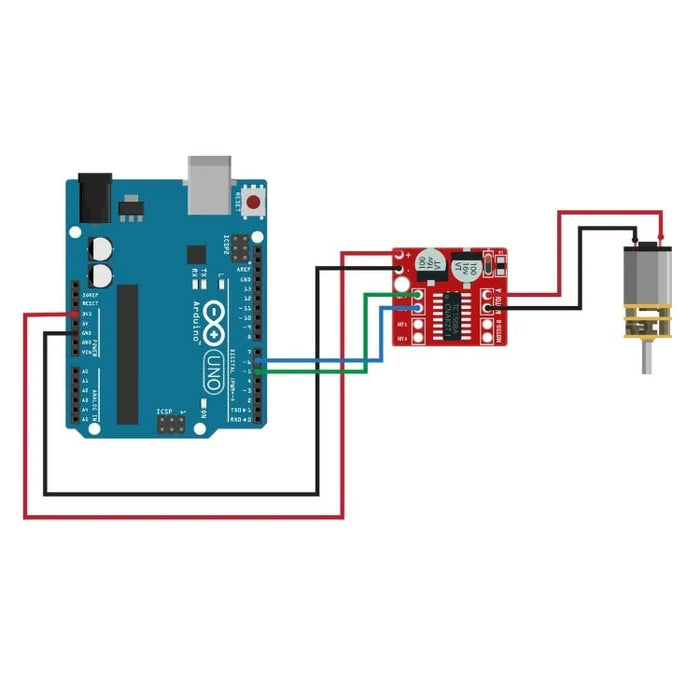
The MX1508 Dual H-Bridge Motor Driver Module is a compact and efficient motor control solution designed for driving DC motors and bipolar stepper motors in robotics and embedded systems. Based on the MX1508 motor driver IC, this module can independently control two DC motors or one stepper motor while supporting bidirectional rotation and PWM-based speed control. Due to its small...
Regular price Rs. 43.00
Regular price Rs. 45.00 Sale price Rs. 43.00
Save Rs. 2
Sold out
Tax included. Shipping calculated at checkout.

Shipping & Returns

Orders placed before 3 PM IST will be shipped on the same day (excluding Sundays and Public holidays) through our shipping partners. In rare cases, the pickup may get delayed during Public holidays / Bandh / Environmental disturbances.

Specifications

Specifications:

Driver IC: MX1508
Motor Channels: 2 DC Motors or 1 Bipolar Stepper Motor
Operating Voltage: 2V to 10V DC
Maximum Output Current: Up to 1.5A Peak per Channel
Continuous Output Current: Approximately 0.8A – 1A per Channel
Control Interface: Digital Logic Input
PWM Support: Yes
Motor Direction Control: Forward and Reverse
Logic Voltage Compatibility: 3.3V and 5V Systems
Number of Input Pins: 4
Operating Temperature: -20°C to +85°C
Module Size: Compact PCB Design
Mounting Type: Through-Hole PCB Connections

FAQ

1. What is the MX1508 Dual H-Bridge Motor Driver Module?

The MX1508 Dual H-Bridge Motor Driver Module is a compact motor control board designed to drive two DC motors or one bipolar stepper motor. It uses the MX1508 driver IC and supports bidirectional motor control with PWM speed regulation, making it ideal for robotics, smart cars, and embedded projects.

2. What types of motors can be controlled using the MX1508 module?

The MX1508 module can control:

  • Two DC brushed motors independently
  • One bipolar stepper motor
  • Small geared motors used in robotics
  • Toy and hobby motors operating within the module's voltage and current ratings

3. How does PWM control work on the MX1508 motor driver?

PWM (Pulse Width Modulation) allows the microcontroller to vary the average power delivered to the motor. By adjusting the PWM duty cycle, the MX1508 module can precisely control motor speed while maintaining efficient power usage.

4. What are the advantages of the MX1508 over the L298N motor driver?

Compared to the L298N, the MX1508 offers:

  • Smaller and lighter design
  • Lower power loss due to reduced voltage drop
  • Better efficiency for low-voltage applications
  • Suitable for battery-powered robots
  • Easy interfacing with Arduino, ESP32, STM32, and other microcontrollers

5. What are the common applications of the MX1508 Dual H-Bridge Motor Driver Module?

The MX1508 module is commonly used in:

  • Line-following robots
  • Obstacle-avoidance robots
  • Smart robotic cars
  • DIY automation projects
  • Educational robotics kits
  • Small motorized devices
  • Stepper motor control applications
  • Arduino and ESP32-based motion control projects
View full product details

The MX1508 Dual H-Bridge Motor Driver Module is a compact and efficient motor control solution designed for driving DC motors and bipolar stepper motors in robotics and embedded systems. Based on the MX1508 motor driver IC, this module can independently control two DC motors or one stepper motor while supporting bidirectional rotation and PWM-based speed control.

Due to its small size, low power consumption, and high efficiency, the MX1508 module is a popular alternative to larger motor drivers such as the L298N, especially in battery-powered and space-constrained applications.

Features

  • Based on the MX1508 Dual H-Bridge Motor Driver IC
  • Controls two DC motors independently
  • Supports one bipolar stepper motor
  • Bidirectional motor rotation control
  • PWM speed regulation support
  • Compact and lightweight design
  • Low voltage drop for improved efficiency
  • Compatible with Arduino, ESP32, STM32, Raspberry Pi, and other microcontrollers
  • Suitable for battery-powered robotics projects
  • Easy-to-use interface with simple control pins