Skip to product information
1 of 5

Official Raspberry Pi Pico WH (Soldered)

SKU: LJBEIV2012
The Raspberry Pi Pico WH is a compact, affordable, and versatile microcontroller development board powered by the RP2040 chip, which was designed by the Raspberry Pi Foundation and introduced in January 2021. It is well suited for learning programming with MicroPython while also offering the flexibility required for a wide range of electronics and embedded projects. The RP2040 microcontroller is...
Regular price Rs. 899.00
Regular price Rs. 999.00 Sale price Rs. 899.00
Save Rs. 100
Sold out
Tax included. Shipping calculated at checkout.

Shipping & Returns

Orders placed before 3 PM IST will be shipped on the same day (excluding Sundays and Public holidays) through our shipping partners. In rare cases, the pickup may get delayed during Public holidays / Bandh / Environmental disturbances.

Specifications

Specifications:

Item Type: Development Board
Model: Raspberry Pi Pico WH
Microcontroller: RP2040
Flash Memory: 2 MB onboard flash
USB Port: Micro USB Type-B
Key Characteristics: High quality, low cost, and widely available
Debug Interface: 3-pin ARM Serial Wire Debug (SWD) port available
Weight: 6 g
Dimensions (L × W × H): 6.2 × 1.5 × 2.1 cm

Additional Resources

FAQ

1. What is the Raspberry Pi Pico WH (Soldered)?

The Raspberry Pi Pico WH is a microcontroller development board based on the RP2040 chip and comes with pre-soldered GPIO headers along with built-in Wi-Fi connectivity. This makes it convenient for quick prototyping using breadboards without requiring manual soldering.

2. What is the difference between Raspberry Pi Pico W and Pico WH?

Both boards offer the same hardware features and wireless capabilities. The main difference is that the Pico WH includes pre-soldered header pins, while the Pico W comes without headers, allowing users to solder them according to their project needs.

3. Does the Raspberry Pi Pico WH support wireless communication?

Yes, the Pico WH includes the Infineon CYW43439 wireless chip, which supports 2.4 GHz Wi-Fi (802.11 b/g/n) and Bluetooth 5.2 hardware. At launch, the board primarily supports Wi-Fi connectivity for networking and IoT applications.

4. Which programming languages can be used with the Raspberry Pi Pico WH?

The Raspberry Pi Pico WH supports MicroPython and C/C++ programming using the official Raspberry Pi SDK. It can also be used with development environments such as Arduino IDE with compatible RP2040 cores.

5. What types of projects can be built using the Raspberry Pi Pico WH?

The Pico WH is suitable for many applications including IoT devices, home automation, robotics, sensor monitoring systems, wireless data logging, and educational electronics projects, thanks to its compact size, wireless connectivity, and flexible GPIO interfaces.

View full product details

The Raspberry Pi Pico WH is a compact, affordable, and versatile microcontroller development board powered by the RP2040 chip, which was designed by the Raspberry Pi Foundation and introduced in January 2021. It is well suited for learning programming with MicroPython while also offering the flexibility required for a wide range of electronics and embedded projects.

The RP2040 microcontroller is built on the Arm Cortex-M0+ architecture and was fully developed in-house by the Raspberry Pi Foundation. It provides reliable performance and efficient processing for various applications.

The Raspberry Pi Pico WH is an upgraded version of the original Pico board. It maintains the same compact form factor but adds built-in 2.4 GHz wireless connectivity, making it suitable for IoT and connected projects.

At the core of the Pico WH is the RP2040 microcontroller, which includes:

  • Dual Arm Cortex-M0+ cores running up to 133 MHz

  • 264 KB of SRAM

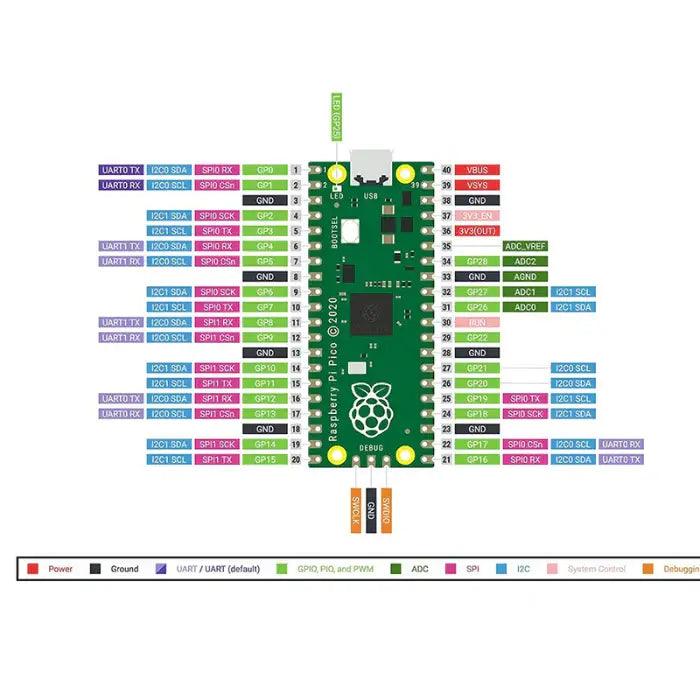
  • 30 GPIO pins

  • A wide range of interfacing options for peripherals and sensors

The Pico W and Pico WH variants include the Infineon CYW43439 wireless chip, which supports IEEE 802.11 b/g/n Wi-Fi and Bluetooth 5.2. At launch, the board primarily supports wireless LAN (Wi-Fi) connectivity.

Features

  • RP2040 microcontroller with 2 MB onboard flash memory

  • 2.4 GHz single-band Wi-Fi (802.11n) for wireless connectivity

  • Micro USB-B port for power supply, data transfer, and firmware updates

  • Compact 40-pin DIP-style PCB (21 mm × 51 mm, 1 mm thick) with through-hole pins and castellated edges

  • 26 multifunction 3.3 V GPIO pins, including 3 ADC-capable inputs

  • 23 digital-only GPIO pins for flexible interfacing

  • Surface-mount capable design for modular hardware integration

  • 3-pin ARM Serial Wire Debug (SWD) interface for debugging and development

  • Flexible power options, including USB, external power supplies, or battery operation

  • Designed for affordability, reliability, and wide availability

  • Comprehensive software support, including SDKs, code examples, and documentation

  • Dual-core Arm Cortex-M0+ processor operating up to 133 MHz

  • On-chip PLL enabling adjustable processor frequency