

Bulk Orders Available
Special Pricing for Schools, Colleges & Businesses


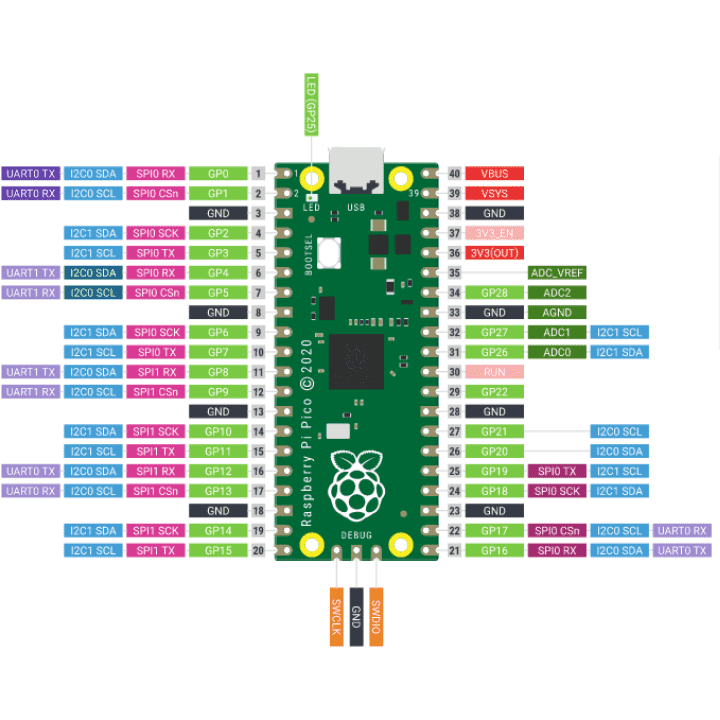
The Official Raspberry Pi Pico W is a great addition to the Pico family, bringing built-in Wi-Fi connectivity to the popular microcontroller board. It is powered by the RP2040 microcontroller, which features a dual-core processor running at up to 133 MHz. The board also includes 2 MB of flash storage and 264 KB of SRAM, providing sufficient memory for a wide range of embedded and IoT projects.
One of the standout features of the Pico W is its integrated wireless capability. With built-in 2.4 GHz Wi-Fi, the board can connect to the internet or operate as a hotspot, making it ideal for IoT devices, smart home systems, and connected electronics projects.
The board provides 26 GPIO pins, including several that support analog input, allowing it to interface with a variety of sensors and electronic components. It also features a USB port for easy programming, power, and data communication. With clear documentation and support for MicroPython, the Raspberry Pi Pico W is beginner-friendly while still offering powerful capabilities for advanced users. Its compact size and strong performance make it suitable for many creative and technical applications.
RP2040 microcontroller designed by Raspberry Pi
Dual-core Arm Cortex-M0+ processor
Flexible system clock running up to 133 MHz
264 KB SRAM and 2 MB onboard flash memory
Integrated 2.4 GHz Wi-Fi (802.11n) connectivity
Castellated edges for direct soldering onto carrier boards
USB 1.1 support with both host and device functionality
Low-power sleep and dormant modes for energy-efficient operation
Drag-and-drop programming via USB mass storage
26 multifunction GPIO pins for flexible interfacing
2 × SPI, 2 × I2C, and 2 × UART communication interfaces
3 × 12-bit ADC channels and 16 controllable PWM outputs
Accurate on-chip clock and time
Built-in temperature sensor
Hardware-accelerated floating-point libraries
8 programmable I/O (PIO) state machines for custom peripheral support
The Raspberry Pi Pico W and Pico WH models use the Infineon CYW43439 wireless chip, which supports IEEE 802.11 b/g/n Wi-Fi and Bluetooth 5.2. At launch, the board primarily supports Wi-Fi connectivity.
The Raspberry Pi Pico W is suitable for many different types of projects, including:
Learning IoT development and electronics prototyping
Home automation and smart device projects
Building small web servers or connected applications
Wireless sensor monitoring systems
Orders placed before 3 PM IST will be shipped on the same day (excluding Sundays and Public holidays) through our shipping partners. In rare cases, the pickup may get delayed during Public holidays / Bandh / Environmental disturbances.